
If you want the short answer, Granito branco marfim generally lasts longer than marble in everyday use, especially in kitchens and busy households. Granite typically rates 6–7 on the Mohs hardness scale, while calcite-based marble is around 3. It also offers greater resistance to scratching and etching from common household acids. Although both materials can last for decades, their maintenance requirements differ: sealing frequency depends on the stone’s porosity, surface treatment, and usage. Marble can retain its beauty for years, but it requires more careful handling to minimize visible wear and acid damage. The key difference is not appearance, but how well each stone maintains its surface under daily use.
What “Lasting Longer” Actually Means for a Natural Stone Surface
Longevity in natural stone is not measured by a single number. A countertop can remain structurally intact for decades yet show significant wear after only a few years because of scratches, etch marks, or persistent stains.
Industry guidance generally distinguishes between two aspects of stone durability: structural integrity and surface appearance under normal use. Granite can remain in service for generations when properly selected, fabricated, installed, and maintained. However, long-term structural performance does not necessarily mean the surface will retain its original appearance.
Both Ivory White Granite and marble can offer decades of service. The difference becomes more noticeable in surface integrity under daily use, where hardness, chemical resistance, and maintenance requirements influence how well each material retains its appearance.
To evaluate countertop durability, consider the conditions the surface regularly faces:
Mechanical wear: Cutting, sliding cookware, and dropped utensils.
Chemical exposure: Acidic foods, beverages, and household cleaning products.
Moisture and staining: Spills that remain on the surface before being wiped away.
Thermal stress: Hot cookware and sudden temperature changes.
Impact damage: Chips and cracks around edges and high-contact areas.
Both materials can withstand everyday use, but they respond differently to these conditions. Marble is more likely to develop visible etching and scratches, particularly in busy kitchens, while granite generally maintains its surface condition with less intensive care.
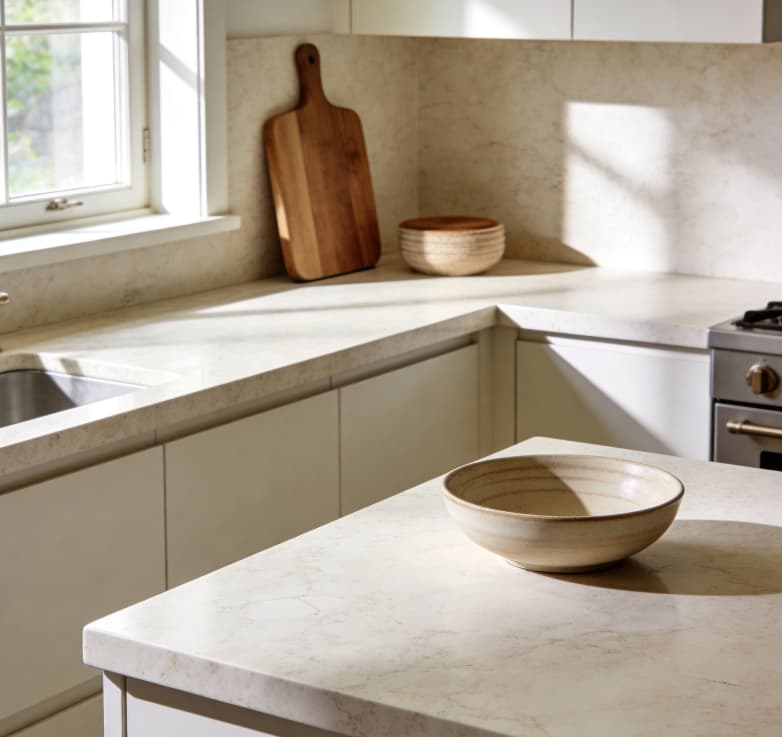
Hardness, Scratch Resistance, and Acid Tolerance: The Core Durability Gap
Ivory White Granite is an igneous rock composed primarily of silicate minerals, including quartz and feldspar. Its mineral composition typically gives granite a Mohs hardness of approximately 6–7, although the actual hardness varies with mineral content. Marble is a metamorphic rock composed mainly of calcite, which has a Mohs hardness of 3. This makes calcite-rich marble more susceptible to scratching and surface abrasion.
The difference in hardness affects how the two materials perform in kitchens. Cutting directly on marble, sliding heavy cookware across its surface, or accidentally striking an exposed edge can leave visible marks or cause chips. Ivory White Granite generally offers greater resistance to these types of everyday wear. However, it is not scratch-proof, and abrasive materials or sufficiently forceful impacts can still damage its surface.
For households that cook frequently, this difference can have a noticeable effect on long-term countertop appearance.
What the Mohs Scale Means at the Kitchen Counter
The Mohs scale becomes easier to understand when compared with common materials. Copper has a hardness of approximately 3, while steel knife blades typically fall around 5–6, depending on their composition and treatment. Quartz has a Mohs hardness of 7, making quartz-bearing particles in everyday dust and grit a potential source of surface abrasion.
These differences help explain why marble countertops in frequently used kitchens can develop fine scratches and gradually lose their polished appearance. Although this wear does not necessarily affect structural integrity, accumulated surface damage can make the countertop look dull and may require professional honing or refinishing.
Why Sealing Doesn’t Solve Marble Etching
One important distinction between granite and marble is their response to acidic substances.
Marble can etch when exposed to lemon juice, vinegar, wine, tomato sauce, and acidic household cleaners. These substances react with calcium carbonate in the stone, dissolving a thin surface layer and leaving dull or whitish marks. Sealing marble can reduce liquid absorption and help prevent staining, but it cannot prevent acid etching because the reaction occurs directly with the mineral surface.
Ivory White Granite, which is predominantly composed of silicate minerals, generally offers much better resistance to etching from common household acids. However, its actual chemical resistance depends on its mineral composition, and areas containing acid-sensitive minerals may still require care. Wiping up acidic spills promptly remains a sensible practice for both materials.
For homeowners comparing long-term countertop appearance, this chemical difference is particularly important. An impregnating sealer can reduce the risk of staining, but it cannot change the underlying chemistry of calcite or make marble acid-proof.
The following table summarizes the main durability differences between the two natural stones.
| Durability Factor | Granito branco marfim | Mármore |
|---|---|---|
| Mohs hardness | Typically 6–7, depending on mineral composition | Around 3 for calcite-rich marble |
| Acid resistance | Generally resistant to common household acids; composition-dependent | Susceptible to etching from acidic substances |
| Water absorption | Generally low; verify the specific slab’s test results | Varies by type; some varieties are more porous and stain-sensitive |
| Sealing requirements | Depends on porosity, finish, and sealer performance | Depends on porosity, finish, and sealer performance |
| Cleaning requirements | Mild detergent and suitable stone cleaners | pH-neutral stone cleaners recommended |
| Scratch resistance | Higher resistance to everyday scratching and abrasion | More susceptible to scratches and surface wear |
| Long-term durability | Can provide decades of service with proper installation and maintenance | Can provide decades of structural service but may require more frequent surface restoration |
Water Absorption, Sealing, and the Real Maintenance Calendar
Ivory White Granite generally has low water absorption, although the exact rate varies by quarry and slab. Some specification sheets list values around 0.20–0.30% by weight, but these figures should be verified against the actual product’s test report. Its sealing needs also depend on porosity, surface finish, and sealer performance rather than a fixed 12–18-month schedule.
Marble’s porosity and chemical sensitivity can make maintenance more demanding. Kitchen marble may require more frequent resealing than some granite varieties, depending on use, finish, and the stone’s absorption rate. pH-neutral stone cleaners are recommended because acidic or abrasive cleaning products can etch or dull the surface over time.
The practical difference is not just sealing frequency. It is the level of care required during daily use. Ivory White Granite generally offers greater resistance to common household acids and routine wear. Marble also performs well with proper care, but it requires more attention to prevent visible etching and surface damage.
How Often Each Stone Actually Needs Sealing
A simple water-drop test can help determine whether resealing may be necessary. Place a few drops of water on a clean, dry area and observe how quickly they absorb. If the stone darkens or absorbs water quickly, it may need resealing. However, this test is only a basic guide; the stone’s condition and the sealer manufacturer’s recommendations should also be considered.
For Ivory White Granite, homeowners can check the surface periodically and reseal when its condition indicates a need. Marble may require more frequent checks, particularly in high-use kitchen areas near the sink or food preparation zones. The actual interval depends on the stone’s porosity, finish, and daily use.
Neither material follows a universal maintenance schedule. Over ten years, the number of resealing sessions will depend on the specific slab and the products used. Buyers should consider the stone’s test results and recommended maintenance requirements rather than rely on fixed estimates for either material.
Cleaning Products and Daily Care Differences
Daily care is another area where the two stones differ. Marble should be cleaned with a pH-neutral stone cleaner or mild soap and water. Avoid acidic products, such as vinegar and citrus-based cleaners, as well as abrasive powders that can damage the finish. Ivory White Granite generally offers better resistance to common household acids, but mild, non-abrasive cleaners remain a suitable choice for routine cleaning.
A few care habits can help preserve the appearance of both materials:
Wipe acidic spills promptly on both surfaces, especially marble, to reduce the risk of etching.
Use cutting boards instead of cutting directly on either stone.
Avoid leaving wet metal cans or cast-iron cookware on the surface, as they may cause rust stains.
Check the surface periodically and reseal when necessary rather than waiting for visible staining.
Avoid abrasive powders and pads, which can dull polished finishes on both stones.

Heat, Impact, and the Everyday Abuse That Shortens a Countertop’s Life
Heat resistance is often oversimplified. Both granite and marble can withstand normal kitchen conditions, but neither is completely heat-proof. Sudden temperature changes can create thermal stress and potentially crack natural stone. Direct contact with very hot cookware may also damage the stone, its finish, or surrounding installation materials, so trivets are recommended for both surfaces.
Ivory White Granite generally has an advantage in hardness and resistance to everyday surface wear. However, edge and impact performance also depend on mineral composition, slab thickness, and installation quality. A pan dropped near the sink or a heavy object striking an exposed countertop edge can damage either material. Marble, particularly calcite-rich varieties, is generally more susceptible to scratches and visible surface marks.
Neither stone is chip-proof. In a busy kitchen, repeated impacts and everyday wear can gradually affect the countertop’s appearance. Marble is more likely to show scratches and etching, while granite generally retains its surface condition better under similar use. Proper handling remains important for both.
Edge Profiles and Fabrication Durability
Edge design matters when selecting a natural stone countertop. Thin or sharply projecting edges are more vulnerable to chipping, particularly around sink cutouts and unsupported overhangs. Because marble is generally softer than granite, rounded or slightly eased edge profiles can be a practical choice for high-use kitchens. The appropriate profile still depends on the slab’s characteristics and intended application.
Fabrication quality affects the service life of both materials. Proper support, accurate seam placement, and adequate overhang reinforcement help reduce stress and prevent cracks. A well-fabricated and properly installed marble countertop can outperform a poorly supported granite surface. Material hardness matters, but workmanship and installation conditions are also critical to long-term durability.
Outdoor and Commercial Performance
Ivory White Granite is often suitable for exterior applications such as cladding, paving, and pool surrounds, provided the specific stone meets the project’s performance requirements. Its suitability depends on factors such as water absorption, strength, surface finish, and freeze-thaw resistance. Marble can also be used outdoors in appropriate conditions, but calcite-rich varieties are more vulnerable to acid rain, weathering, and surface erosion. Climate and maintenance requirements should be considered before selecting either material.
Commercial settings place additional demands on natural stone surfaces. Restaurant counters, hotel vanities, and high-traffic reception areas face frequent cleaning, spills, and repeated contact. Ivory White Granite can be a practical choice where scratch resistance and lower sensitivity to common acids are priorities. Marble remains an option for design-focused spaces, but buyers should account for its greater susceptibility to etching and potential refinishing requirements.
Real-World Scenarios and the Long-Term Cost Math
A busy family kitchen with daily cooking and acidic ingredients
This is where Ivory White Granite’s durability advantages become more noticeable. Tomato sauces, citrus, vinegar-based dressings, and wine are common kitchen spills. On granite, they are generally easier to manage. On marble, they can cause etch marks that sealing cannot prevent. A household that cooks five or more nights a week may notice the difference over time, particularly if acidic spills are not cleaned promptly.
A bathroom vanity used for cosmetics and grooming
Marble performs better here than in a kitchen because acidic food exposure is lower and the surface usually experiences less intensive use. Many homeowners choose marble for bathrooms because the risk of damage is more manageable and its visual appeal is significant. Ivory White Granite also works well on vanities, although its higher durability may exceed what a typical bathroom requires.
An outdoor kitchen or patio surface
Ivory White Granite can perform well outdoors when the specific variety is suitable for local weather conditions. Marble may show greater surface degradation from weathering, particularly in environments with acid rain and repeated temperature changes. For pool surrounds, outdoor kitchens, and covered patios, suitable granite varieties are often the more practical natural stone choice.
Commercial and food service applications
In restaurants, cafes, and hospitality environments, countertops face frequent spills, heavy cookware, and repeated cleaning. Ivory White Granite’s hardness and general resistance to common acids make it a practical option for these settings. Specifiers typically prioritize surfaces that maintain their appearance under commercial cleaning routines, although the selected stone must also meet the project’s hygiene and maintenance requirements.
The following table summarizes the broader ownership and performance considerations.
| Consideration | Granito branco marfim | Mármore |
|---|---|---|
| Five-year maintenance cost | Depends on stone, sealing, and local labor costs | Depends on stone, sealing, refinishing, and local labor costs |
| Outdoor suitability | Suitable varieties perform well in exterior applications | More vulnerable to weathering in exposed environments |
| Resale positioning | Broad appeal among buyers seeking durable natural stone | Luxury appeal, particularly in design-focused properties |
| Tolerance for real kitchen use | Generally higher resistance to scratches and etching | More sensitive to scratches and acid exposure |
| Best-fit rooms | Kitchens, high-traffic flooring, commercial surfaces, suitable exteriors | Bathroom vanities, fireplace surrounds, low-impact areas |
The cost of keeping stone looking new over ten years
Upfront price is only part of the durability equation. Maintenance spending also affects the long-term cost difference between the two materials.
Actual maintenance costs depend on the stone’s porosity, surface finish, usage, and local service rates. Marble may require more frequent attention to etching and occasional refinishing, while Ivory White Granite generally involves less intensive routine care. Over a decade, these differences can influence total ownership costs, although neither material follows a universal maintenance schedule.
These costs do not include the decision to live with visible etch marks rather than pay for refinishing. Many marble owners eventually accept a natural patina instead of trying to maintain a factory finish. That is a legitimate design choice, but it represents a different expectation of long-term appearance.
Resale value and buyer confidence
Granite’s durability reputation can influence buyer perceptions. Its resistance to everyday wear and relatively straightforward maintenance may appeal to homeowners seeking practical surfaces. However, resale returns depend on property location, overall condition, and buyer preferences. A fixed ROI range for granite cannot be applied reliably to every market. Marble may command a premium in certain luxury properties, but its maintenance requirements and susceptibility to etching may influence how potential buyers evaluate it.
Ivory White Granite benefits from the practical reputation of granite while offering a warm, neutral white appearance that complements many interior styles. This combination can support its appeal in residential projects, although resale value ultimately depends on how well the material’s appearance and condition suit the property and its target market.
The Honest Caveat: When Marble’s Shorter Surface Life Is Still the Right Trade
Marble remains a distinctive decorative material. Its natural veining creates patterns that differ from granite’s mineral texture, giving it a visual character that many homeowners value. In a bathroom, a low-traffic bar area, or a home where the owner appreciates regular maintenance, marble’s aesthetic appeal can justify its greater care requirements.
However, in a kitchen with frequent acidic spills and heavy use, marble is more likely to develop visible etching and scratches. Ivory White Granite generally requires less maintenance and offers better resistance to common sources of surface wear. The choice depends on how much importance the homeowner places on appearance versus everyday durability.
There is also a practical compromise: using marble as an accent, such as a backsplash, an island surface in a low-acid preparation area, or a fireplace surround, while choosing Ivory White Granite for the main work surfaces. This approach preserves marble’s visual appeal without exposing it to the conditions that make it more difficult to maintain.
Conclusão
Ivory White Granite offers better everyday durability than marble, with greater scratch resistance, no acid etching from common foods, and generally less frequent sealing. It also tolerates a wider range of cleaning products and is better suited to outdoor applications when properly selected and installed. Although marble can last for decades, its surface is more vulnerable to scratches, acidic spills, and everyday wear. If long-term durability and easier maintenance are your priorities, Ivory White Granite is the more practical choice, combining reliable performance with a warm white appearance that complements both modern and traditional interiors.
Explore the Ivory White Granite slabs, tiles, and cut-to-size options from Pedra de abastecimento, and contact our team for product specifications and samples to find the right match for your project.