Dark rooms present a persistent design challenge: limited daylight, low ceilings, and surfaces that absorb rather than reflect light. Λευκό μάρμαρο Polaris can help improve perceived brightness through its light-colored base, reflective surface finishes, and crystalline structure. This article explores how Polaris White Marble performs in low-light interiors, which finishes are most suitable, and what designers and buyers should consider when selecting slabs for interior projects.
The Optical Logic: How White Marble Improves Perceived Brightness
A dark interior often feels dim for two reasons: insufficient natural or artificial light, and surfaces that absorb rather than reflect the available light. Polaris White Marble can help address the second issue. Its near-white base provides a light-colored surface that reflects incoming light, while a polished finish creates directional reflections that can redirect some illumination toward ceilings and adjacent walls.
Three optical characteristics contribute to the brightness effect of Polaris White Marble:
- Light-colored base: Helps reflect ambient light and reduces the visual weight of darker surfaces.
- Surface reflectivity: A polished finish creates stronger directional reflections, while honed finishes provide a more subdued appearance.
- Crystalline structure: Depending on slab thickness and mineral composition, limited light transmission may add visual depth to certain applications.
Base Color, Veining, and Visual Temperature
Polaris White is generally described by suppliers as a soft, milky white marble with delicate grey veining and occasional faint gold accents, rather than a stark blue-white stone. This warmer appearance can help maintain a balanced interior palette, particularly when the marble is paired with timber, brass, and warm artificial lighting. By contrast, cooler white surfaces may appear more clinical under certain lighting conditions. The overall effect depends on the stone’s actual background tone, veining pattern, and the color temperature of the surrounding light. For this reason, Polaris White Marble slabs should be evaluated under the lighting conditions planned for the project.
Translucency and the Crystalline Structure
Polaris White Marble is a dolomitic marble quarried in the Kavala region of Macedonia, Greece. Some descriptions of the material highlight its translucent appearance, although the degree of light transmission depends on slab thickness, mineral composition, and veining. In applications such as vanity tops and backlit wall panels, thinner sections may allow limited light transmission, creating visual depth between the stone surface and the lighting behind it. However, this effect should be confirmed with a physical sample before specifying backlit installations. Marble remains a reflective decorative material, not a substitute for an independent light source.
Surface finish also influences how the stone interacts with light. A polished finish produces stronger specular reflections, enhancing the appearance of brightness when light strikes the surface. A honed finish reduces sharp reflections and creates a softer, more uniform visual effect, which may be preferable in spaces where direct lighting could cause glare. The choice between polished and honed Polaris White Marble should therefore consider the lighting layout, intended application, and maintenance requirements rather than appearance alone.
Polaris White Marble’s Material Profile: Balancing Brightness and Durability
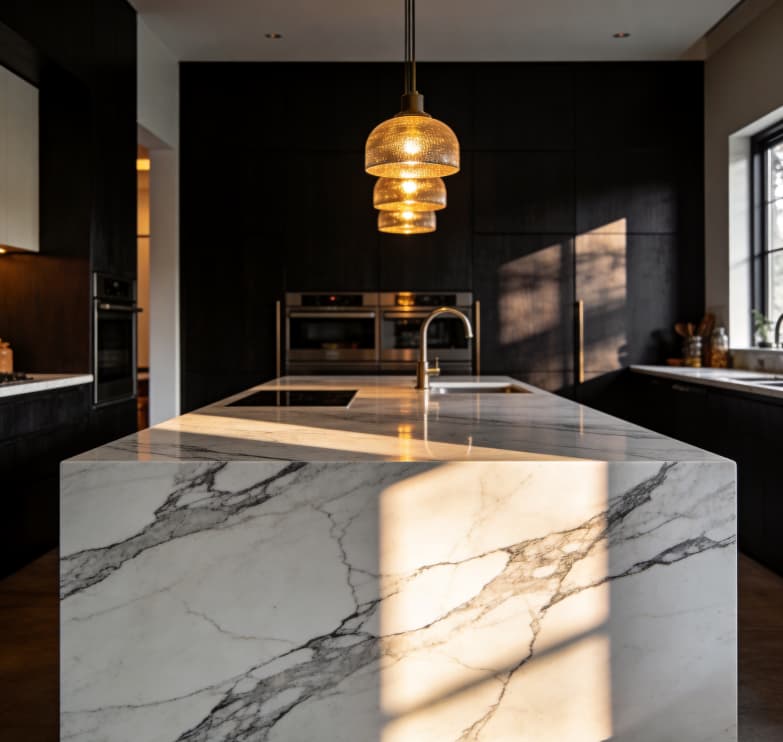
A marble surface may improve the perceived brightness of a room, but it must also meet the performance requirements of its intended application. This is particularly important in dark interiors, where designers often use large, continuous surfaces such as full-height wall cladding, expansive flooring, and kitchen islands to create a brighter visual effect. The material’s physical properties, therefore, need to be considered alongside its appearance.
Polaris White is a dolomitic marble, a composition generally associated with higher hardness and lower water absorption than typical calcitic marble. Supplier-reported technical data indicate a density of approximately 2.62–2.84 g/cm³, water absorption of 0.15–0.36%, and compressive strength of roughly 80–151 MPa. Its Mohs hardness is reported at 4–5, which is typical of marble. These properties can support various interior applications, although the stone remains more susceptible to scratching and acid etching than granite and many engineered surfaces.
For brightness-focused interior projects, these properties have several practical implications:
- Large-format wall cladding: Density and mechanical strength should be evaluated alongside panel dimensions, thickness, and fixing methods.
- Kitchen and bathroom applications: Relatively low water absorption can help limit moisture penetration, although sealing and routine maintenance are still necessary.
- Thin or backlit panels: Flexural strength and slab consistency should be verified before specifying thin sections or suspended installations.
- Countertops and flooring: Marble’s moderate hardness requires appropriate surface protection, including cutting boards, trivets, and non-abrasive stone cleaners.
These figures represent reported ranges rather than guaranteed specifications for every Polaris White Marble slab. Actual performance may vary by quarry block, production lot, and testing method. Buyers should request current technical data sheets and lot-specific test results before confirming material suitability, panel dimensions, or fabrication requirements.
Table 1: Technical Properties of Polaris White Marble and Their Relevance to Interior Applications
| Parameter | Reported Supplier Data | Relevance to Interior Applications | Specification Considerations |
|---|---|---|---|
| Base color | Milky to alabaster white, with grey veining and occasional faint gold accents | A light background helps create a brighter visual appearance | Review full-slab photos or physical samples under project lighting |
| Surface finish | Polished, honed, and other finishes available | Polished produces stronger directional reflections, while honed provides a softer appearance | Confirm finish availability, gloss level, and maintenance requirements |
| Πυκνότητα | Approximately 2.62–2.84 g/cm³ | Relevant to material weight and handling requirements for large-format panels | Verify actual density when calculating panel weight and installation loads |
| Water absorption | Approximately 0.15–0.36% (reported values) | Helps assess moisture penetration and sealing requirements | Confirm the test method and consult the sealer manufacturer |
| Αντοχή σε θλίψη | Approximately 80–151 MPa (reported range) | Provides reference data for evaluating material suitability under compressive loads | Verify lot-specific results and applicable testing standards |
| Flexural strength | Approximately 8.7–23 MPa (reported range) | Important when evaluating thin panels and unsupported spans | Confirm test data, panel dimensions, and support conditions |
| Mohs hardness | 4–5 (reported) | Indicates moderate scratch resistance compared with harder stones | Use appropriate surface protection and non-abrasive cleaning products |
| Translucency | Described as having limited translucency in thin sections | May provide visual depth in selected backlit applications | Test actual slab samples for light transmission and veining variation |
Where Polaris White Marble Delivers the Greatest Brightness Gain
The brightness effect of a surface depends largely on its exposure to natural or artificial light and its position within the room. Polaris White Marble can make the greatest visual contribution when installed on surfaces that receive sufficient illumination or remain within the viewer’s main field of vision. Its light background and reflective finish can help distribute available light while making darker interiors feel more open.
Vertical Surfaces and the “Light Wall” Strategy
A full-height Polaris White Marble feature wall can serve as a secondary reflective surface. In a room with limited daylight, positioning the marble wall opposite or adjacent to a window may help redirect incoming light toward other parts of the space. A polished finish creates more directional reflections than a matte painted surface, while natural veining adds visual variation to large wall installations. These characteristics make Polaris White Marble a suitable option for feature walls, fireplace surrounds, and large-format interior wall cladding.
Floors, Kitchen Islands, and Bathroom Applications
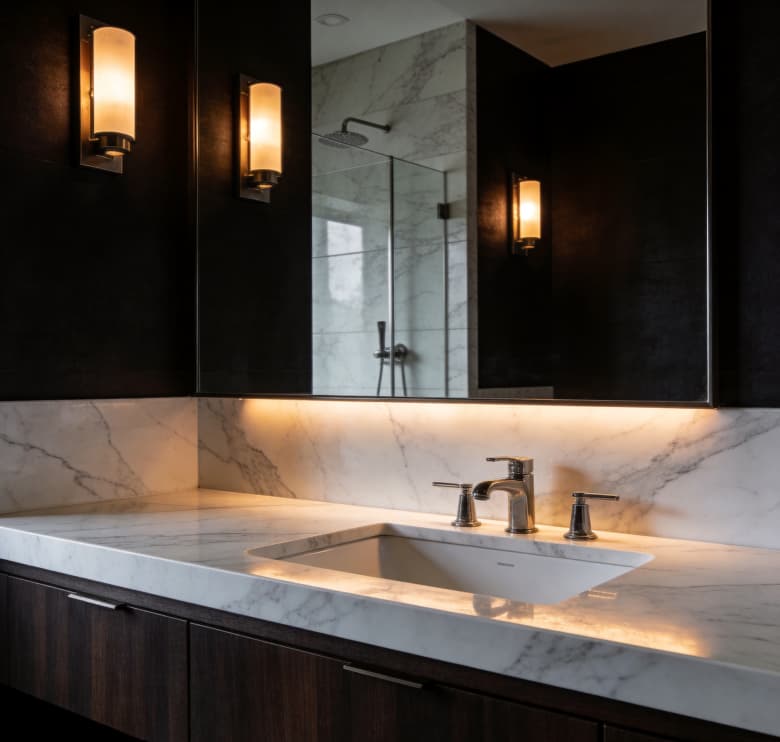
Polaris White Marble flooring can brighten the lower visual field, particularly in rooms with dark adjacent finishes or limited natural light. In kitchens, marble islands and countertops introduce light-colored horizontal surfaces that can reflect pendant and under-cabinet lighting. In bathrooms, the stone can be used for vanity tops, shower surrounds, and wall cladding. Its reported low water absorption may support these applications when combined with appropriate sealing and maintenance, although surface treatment and installation details remain important.
For commercial interiors such as hotel lobbies and boutique retail spaces, 2 cm marble slabs may be considered for flooring, subject to project-specific load requirements, substrate conditions, and installation methods. The appropriate slab thickness should be confirmed with the stone supplier and installation contractor rather than treated as a universal specification.
For dark interior projects, the following placement priorities can help guide material selection:
- Well-lit vertical surfaces: Feature walls positioned to receive daylight or directed artificial lighting.
- Horizontal work surfaces: Kitchen islands, countertops, and vanity tops within the main field of vision.
- Flooring areas: Large floor sections that introduce a lighter visual base to the room.
- Accent surfaces: Smaller marble elements that create contrast without requiring extensive material coverage.
Where It Does Not Solve the Problem
Polaris White Marble cannot compensate for inadequate lighting on its own. In windowless basements or rooms with insufficient artificial illumination, even highly reflective white surfaces will have limited impact. A dark ceiling, poorly positioned light fixtures, or areas that receive little direct or indirect light can also restrict the overall brightness effect. The stone reflects available light; it does not generate illumination. For the best results, Polaris White Marble should be incorporated into a coordinated lighting and interior design strategy rather than treated as a replacement for adequate lighting.
Designing with Polaris White Marble: Contrast, Coordination, and Finish Selection
The visual brightness of Polaris White Marble depends not only on the stone itself but also on the materials and colors surrounding it. Against dark walnut, blackened steel, or deep green cabinetry, its light background creates a stronger visual contrast. When paired with mid-tone greys or other light materials, the effect is softer and more integrated. The key is to coordinate surrounding finishes with the intended visual effect.
Pairing with Dark and Warm Materials
The warm white background and subtle grey or gold veining of Polaris White Marble can complement materials that add depth to darker interiors. Three combinations are particularly suitable:
- Dark oak or walnut cabinetry: Creates a bright contrast along kitchen islands, countertops, and other working surfaces.
- Dark wall finishes: A Polaris White Marble floor introduces a lighter visual base and balances darker vertical surfaces.
- Dark feature walls: A white marble fireplace surround creates a focal point through material contrast without requiring additional decorative lighting.
Polished Versus Honed: Which Finish Brightens More?
A polished finish generally creates stronger specular reflections and can make Polaris White Marble appear brighter when light strikes the surface at a suitable angle. However, it may also make surface scratches, acid etching, and glare more noticeable, particularly under direct lighting. A honed finish produces a softer, less reflective appearance, which may be preferable in spaces where visual comfort is a priority. For dark interiors with directional lighting, honed marble can help limit sharp reflections, while polished marble may be more suitable when the design aims to emphasize surface reflectivity. The final choice should account for lighting direction, application, maintenance requirements, and the desired appearance.
Table 2: Finish and Application Choices for Polaris White Marble in Dark Interiors
| Design Decision | Option A | Option B | Brightness Implication | Practical Trade-Off |
|---|---|---|---|---|
| Surface finish | Γυαλισμένο | Κομμένο | Polished generally creates stronger directional reflections, while honed provides a softer appearance | Polished surfaces may show glare and surface damage more readily; honed surfaces produce less pronounced reflections |
| Primary placement | Full-height feature wall | Floor field | A well-positioned wall can reflect light toward other parts of the room, while flooring creates a lighter visual base | The effect depends on light exposure, surface orientation, and room layout |
| Contrast strategy | White marble against dark cabinetry or walls | White marble against mid-tone or warm neutrals | Strong contrast makes the marble stand out more clearly, while tonal combinations create a more integrated appearance | High contrast creates a bolder visual effect; low contrast produces a softer palette |
| Edge profile | Flat-polished edge | Bullnose or ogee | Edge profiles have little influence on the overall brightness of the space | Profile selection mainly affects appearance, edge protection, and suitability for the application |
| Slab selection | Consistent background with subtle veining | Bookmatched slabs or more pronounced veining | A relatively uniform background creates a more continuous visual surface, while prominent veining adds visual variation | Dramatic veining creates a stronger decorative statement but may interrupt the visual continuity of large surfaces |
Maintenance and Long-Term Luminosity: Keeping Polaris White Marble Bright
White marble can lose its visual appeal through staining, acid etching, and surface wear. Polaris White Marble is a natural stone that requires appropriate sealing and routine care to maintain its appearance. Its reported dolomitic composition and relatively low water absorption may offer an advantage in moisture-related applications, but they do not eliminate the need for maintenance or protect the surface from chemical damage.
Sealing and Stain Management
A practical maintenance routine for Polaris White Marble includes four steps:
- Apply a suitable penetrating sealer during installation, following the manufacturer’s application and curing instructions.
- Reapply the sealer according to the product guidance and the stone’s actual use, rather than relying on a fixed annual schedule.
- Clean with pH-neutral stone cleaners and avoid acidic or abrasive products.
- Blot spills promptly, particularly liquids that may cause staining, instead of allowing them to remain on the surface.
Sealing can reduce the penetration of certain liquids, but it does not make marble stain-proof or acid-resistant. Using suitable cleaning products and addressing spills promptly are therefore essential to maintaining the stone’s appearance.
Etching, Patina, and Realistic Expectations
Marble is sensitive to acids. Lemon juice, vinegar, wine, and some household cleaners can react with the stone’s surface, causing etching that appears as a dull mark or loss of polish. This is an inherent characteristic of marble rather than a defect specific to Polaris White. In dark interiors, visible changes to the surface may interrupt the consistent reflective appearance of polished marble. Owners should understand that working surfaces may develop signs of use over time. A honed finish can make some surface changes less visually pronounced, although it does not prevent acid etching.
Sourcing Polaris White Marble for Brightness-Critical Projects
Polaris White is associated with the Kavala region of northern Greece and may be marketed under related trade names, including Kavala White, Kavala Semi-White, or Kavala Crystal Marble. However, trade names and commercial descriptions can vary between suppliers. Buyers should not assume that materials sold under similar names have identical background tones, veining patterns, or translucency. For projects where visual brightness is a key design requirement, evaluating the actual slabs before approval is essential.
What to Verify Before Approving a Slab
Buyers should request physical samples or full-slab photographs under lighting conditions that are as close as possible to those of the finished project. A practical verification process should cover five points:
- Base tone: Check whether the background appears warm or cool under the intended lighting.
- Veining density: Review the pattern across the full slab rather than relying only on a small sample.
- Thickness and finish: Confirm that both meet the requirements of the intended application and installation.
- Lot consistency: Check color and pattern variations when multiple slabs will be installed together.
- Fabrication feasibility: Confirm suitability for thin panels, backlit applications, or large monolithic pieces before production.
Slabs with dense or prominent veining may create a visually darker overall effect than those with a more uniform background. Full-slab inspection is therefore important when selecting Polaris White Marble for brightness-focused interiors.
Commercial Terms and Lot Consistency
Available slab dimensions, thicknesses, finishes, and minimum order quantities vary by supplier and current stock. Some suppliers may offer large-format slabs or custom cutting, while others may require project-specific order quantities. Buyers should request an updated quotation that identifies the selected slabs, dimensions, thickness, finish, quantity, and any additional processing costs. Prices per square meter should be evaluated against the actual material selection rather than treated as a fixed rate for all Polaris White Marble.
For projects requiring several slabs across continuous wall or floor areas, buyers should also confirm whether the selected material comes from the same production lot. Reserving suitable slabs before fabrication can help reduce visual differences between adjacent sections. The supplier should clarify stock availability and how long the selected material can be held for the project.
Custom Fabrication and Project Support
Polaris White Marble can be processed into tiles, slabs, countertops, vanity tops, wall panels, and other custom pieces, depending on slab dimensions and fabrication capabilities. Common edge profiles include flat, bevel, bullnose, and ogee. For applications such as backlit wall panels or monolithic islands, buyers should confirm the fabricator’s ability to control thickness, match slab sections, and meet the installation requirements. Fabrication drawings and dry-lay photographs can also help verify dimensions and veining continuity before final installation.
ΣΥΧΝΈΣ ΕΡΩΤΉΣΕΙΣ
Q: Does Polaris White Marble Actually Make a Room Brighter?
Yes, to a degree. Its light-colored surface reflects available natural and artificial light, helping dark interiors appear brighter. A polished finish can create stronger directional reflections, but Polaris White Marble does not generate light or replace adequate lighting.
Q: Is Polaris White Marble Too Cold for Warm Interior Palettes?
No. Its milky white background and subtle grey or gold veining can complement timber, brass, and warm-neutral finishes. However, the final appearance depends on the slab’s actual tone and the surrounding lighting, so review a physical sample before selection.
Q: Which Finish Maximizes Brightness in a Low-Light Room?
A polished finish generally creates stronger directional reflections, while a honed finish provides a softer appearance with less glare. The choice depends on lighting conditions, maintenance expectations, and the desired surface effect.
Q: Can Polaris White Marble Be Used for Flooring in Dark Rooms?
Yes. Its light background can create a brighter visual base. However, slab thickness, finish, substrate, and installation methods must suit the project. A honed finish may help reduce glare, but slip resistance should be verified separately.
Q: How Does Polaris White Marble Compare with Engineered White Stone?
Engineered quartz and sintered surfaces offer more consistent colors and patterns, while Polaris White Marble provides natural veining and variation. Marble requires sealing and is susceptible to acid etching, so the choice depends on the preferred appearance and maintenance requirements.
Q: What Is the Most Common Mistake When Using Polaris White Marble in Dark Interiors?
Treating the marble as a substitute for lighting design is a common mistake. Another is selecting slabs from small samples alone. Review full-slab patterns and coordinate material selection with the room’s lighting plan.
Συμπέρασμα
Polaris White Marble can help brighten dark interiors through its light-colored background, reflective finish, and natural veining. However, the final effect depends on lighting conditions, surface selection, and the characteristics of each slab. Choosing the right material requires more than comparing white tones; buyers should also consider finish, dimensions, consistency, and application requirements. If you are planning an interior project, contact Souring Stone to explore available Polaris White Marble slabs, confirm product specifications, and request samples for evaluation. Selecting the right slab can help bring the intended brightness and visual balance to your space.