Quick Summary:Panda White Marble is a distinctive Chinese natural marble recognized for its bright white background and dramatic black veining. This guide explores Panda White Marble Slabs, countertop applications, surface finishes, technical properties, quality inspection, and how to select a reliable Panda White Marble Supplier for residential, commercial, and wholesale projects.
A Natural Black-and-White Statement for Contemporary Architecture
Some natural stones create a quiet background, while others become the defining feature of an interior. Marbre blanc Panda belongs to the second category. Its strong contrast between a crystalline white base and bold black or dark grey veins gives architects, designers, fabricators, and property developers a material that can function as both a surface and a visual focal point.
For residential projects, this marble can introduce a distinctive appearance to kitchen islands, bathroom vanities, feature walls, flooring, and decorative furniture. In hospitality and commercial interiors, its dramatic pattern can create memorable reception counters, wall panels, and carefully coordinated floor designs. The natural variation of each slab also means that every installation has its own visual character.
However, selecting marble for a real project involves more than choosing an attractive photograph. Buyers need to consider physical properties, slab consistency, thickness, surface finish, fabrication requirements, installation conditions, maintenance expectations, and the supplier’s quality-control process. These factors become particularly important when ordering multiple slabs or coordinating a large commercial project.
Understanding the manufacturer’s capabilities and product documentation is an important first step. Buyers evaluating a natural stone manufacturer in China should review its processing equipment, inspection procedures, export experience, and ability to provide consistent order information. A supplier’s production capabilities should be assessed alongside the appearance of the material, rather than treated as a separate purchasing consideration.
What Is Panda White Marble?
Panda White Marble is a natural marble known for its predominantly white background and prominent black or dark grey veining. The contrast can range from relatively controlled linear patterns to large, irregular movements that cross the slab and create a strong graphic effect. It is commonly selected for interiors where the stone is expected to attract attention rather than disappear into the overall design.
Marble is a metamorphic rock formed when carbonate-rich rocks, commonly limestone or dolostone, undergo changes caused by heat, pressure, and geological fluids. During metamorphism, the original mineral structure recrystallizes. Differences in mineral composition and geological conditions contribute to the colors, veins, and patterns visible in the finished stone.
The product information published for this material identifies its origin as China. Its visual identity is based on a white crystalline-looking background with pronounced dark veins. Buyers should nevertheless distinguish between a commercial stone name and a complete geological classification. The name alone does not provide enough information to establish the exact mineral composition, quarry characteristics, or performance of every production lot.
For buyers comparing different natural stone categories, it is useful to review the broader marble product collection and understand how different varieties compare in appearance, application, finish, and technical performance. This provides a more informed starting point for matching a material to the design and functional requirements of a project.
Distinctive Black and White Veining Patterns
The defining feature of this marble is its visual contrast. White areas provide brightness and visual space, while black veins introduce movement, depth, and direction. Depending on the selected block, the dark pattern may appear as broad sweeping bands, irregular branches, or a combination of thick and fine lines.
This pattern makes slab selection especially important. Two slabs from the same material category may have noticeably different vein positions, dark-to-white ratios, and visual movement. For a small vanity top, such variation may be relatively easy to accommodate. For a large feature wall or a multi-panel reception counter, it can determine whether the completed installation looks coordinated.
Natural Variation and Geological Characteristics
Natural marble should not be evaluated using the same expectations as a printed surface or a manufactured material with a controlled pattern. Mineral distribution, geological fissures, color changes, and vein direction are part of the natural stone’s character. These variations are not automatically defects, but they must be evaluated against the project’s approved sample and quality requirements.
For large orders, buyers should request photographs or videos of the actual available slabs. A sample tile can communicate the general color and texture, but it cannot fully represent the movement of a full-size slab. A confirmed slab selection record is particularly useful when multiple pieces will be installed next to one another.

Key Characteristics and Physical Properties
Appearance is only one part of a material specification. A professional Panda White Marble Slabs evaluation should include water absorption, bulk density, compressive strength, flexural strength, surface condition, and dimensional accuracy. These properties influence how the stone should be fabricated, supported, installed, and maintained.
Published Technical Data and What Buyers Should Verify
The following table summarizes the technical figures displayed in the product information. They should be treated as supplier-published reference data rather than independent laboratory verification. In particular, the density unit requires confirmation because the displayed unit and numerical value appear inconsistent with conventional density reporting for dimension stone.
| Propriété | Published Figure | Buyer Verification Point |
|---|---|---|
| Water absorption | 0.25% | Confirm test method and sample batch |
| Densité | 2.73 (unit shown as kg/m³) | Confirm the correct unit and laboratory report |
| Résistance à la compression | 195 MPa | Confirm test direction, moisture condition, and method |
| Flexural strength | 10.9 MPa | Confirm specimen dimensions and test method |
These figures should not be used as universal design values without supporting test documentation. Natural stone properties can vary between blocks and production lots. For structural applications, exterior cladding, or installations subject to significant loads, project engineers should use verified test results and the relevant design criteria.
Density, Water Absorption, and Porosity
Water absorption describes the amount of water a stone specimen takes up under a specified test procedure. It is relevant to stain risk, moisture exposure, and the selection of protective treatments. However, absorption alone does not determine whether a stone is suitable for a particular installation. Surface finish, pore structure, joint design, installation materials, and maintenance practices also matter.
For kitchen and bathroom applications, buyers should ask whether the supplied material has been tested and whether a compatible impregnating treatment is recommended. A treatment may improve resistance to staining, but it does not make marble completely stain-proof or prevent chemical etching.
Hardness, Durability, and Scratch Resistance
Marble is generally more sensitive to scratching and acidic substances than many granite and quartzite varieties. This does not mean that it cannot be used in frequently occupied interiors. It means the material should be matched to the expected use and maintained according to its mineral characteristics.
For a kitchen countertop, the user should understand that lemon juice, vinegar, wine, and some acidic cleaners may react with calcite-rich marble. The result can be an etch mark that changes the surface sheen even when no colored stain remains. Cutting directly on the surface and dragging heavy cookware can also cause scratches or localized damage.
Typical Slab and Tile Thickness Options
Thickness should be selected according to the intended application, structural support, fabrication method, and local project specification. The product information lists several recommended tile formats at 18 mm thickness, while customized dimensions may also be available. The following table provides a practical planning reference, not a substitute for the supplier’s current stock list or engineering approval.
| Format | Example Thickness | Typical Planning Use |
|---|---|---|
| 300 × 600 mm tile | 18 mm | Wall and selected floor applications |
| 600 × 600 mm tile | 18 mm | Interior floors and walls |
| 457 × 457 mm tile | 18 mm | Residential flooring and renovation |
| 800 × 800 mm tile | 18 mm | Large-format interior flooring |
| 900 × 900 mm tile | 18 mm | Selected spacious interior projects |
| Custom slab or cut-to-size panel | Project-specific | Countertops, islands, walls, and bespoke fabrication |
Where Can Panda White Marble Be Used?
The material’s dramatic contrast makes it suitable for projects that need a recognizable natural-stone feature. It is especially effective when the design allows the veining to remain visible across a sufficiently large surface. The final selection should still consider moisture exposure, abrasion, support, maintenance, and the availability of matching slabs.
Comptoirs de cuisine et îlots
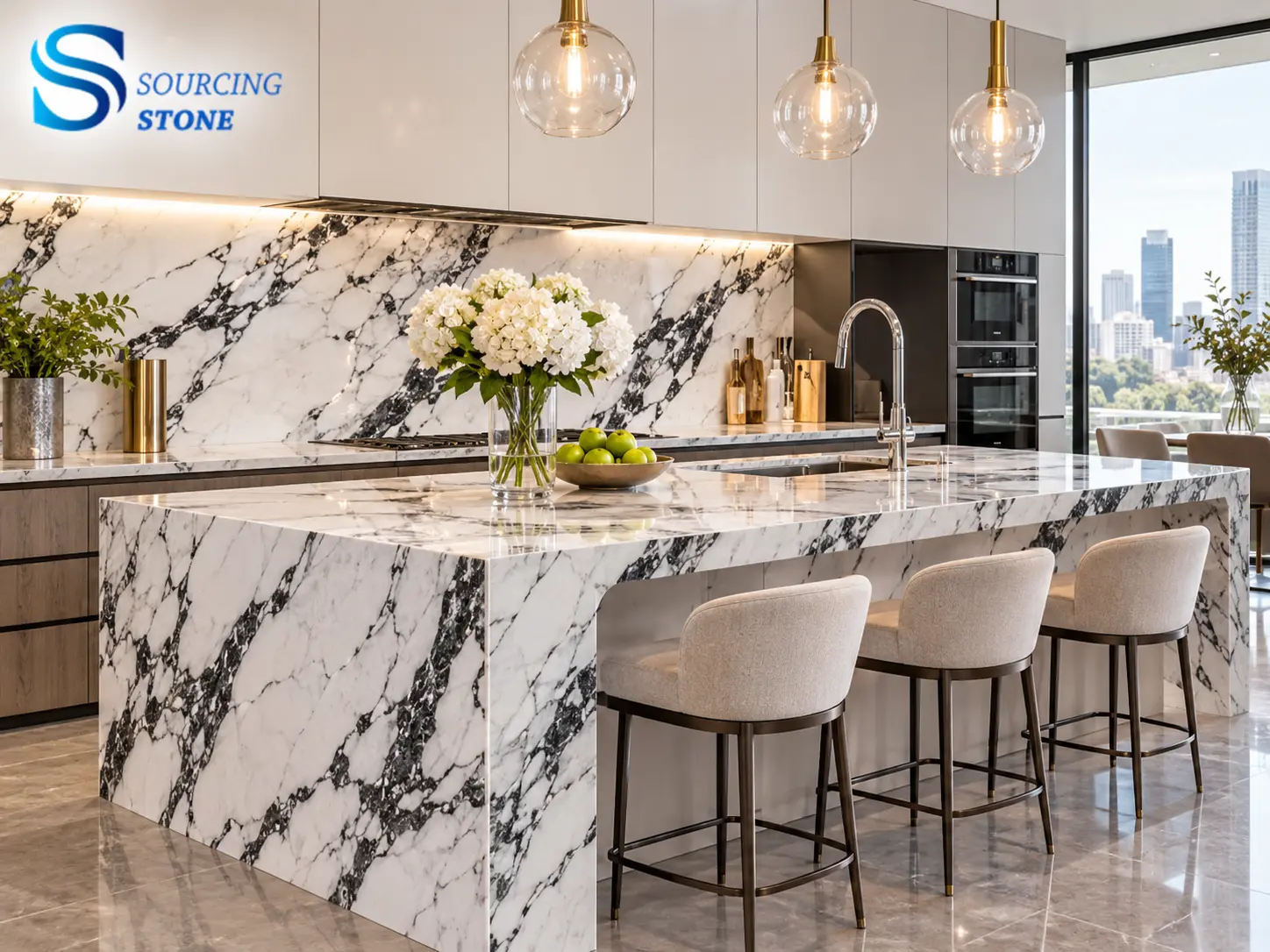
Panda White Marble Countertops can create a strong focal point in contemporary kitchens. A white background helps maintain a bright appearance, while black veins add movement to islands, breakfast bars, and perimeter counters. Waterfall island edges can make the pattern more prominent, especially when the fabricator plans the vein direction before cutting.
Marble is not maintenance-free. Acidic foods, oils, coffee, and strongly colored liquids should be cleaned promptly. Buyers who prioritize low maintenance may prefer granite, quartzite, or engineered quartz for heavily used preparation areas. If marble is selected, specify a suitable finish, edge profile, protective treatment, and care instructions before installation.
Bathroom Vanities, Shower Walls, and Decorative Panels
Bathroom vanities and wall panels are common applications because the stone can create a coordinated visual effect across countertops, splashbacks, and vertical surfaces. For wet areas, the installation design should address waterproofing behind the stone, correct substrate preparation, joint sealing, drainage, and compatible fixing materials.
For shower floors, the choice requires additional care. A polished surface may become slippery when wet, depending on the stone, tile dimensions, slope, and grout layout. Smaller formats can increase the number of joints and may help accommodate drainage, but the final slip-resistance performance must be evaluated as a complete installed system rather than inferred from the material name.
Flooring, Wall Cladding, and Feature Walls
Large-format panels can create a continuous visual statement in hotel lobbies, reception areas, retail interiors, and residential living rooms. A dramatic vein pattern can be used as a focal wall behind a reception desk or as a decorative panel around a fireplace. Flooring applications require more attention to traffic, abrasion, slip resistance, and long-term maintenance.
For exterior cladding, the design team must not assume that an attractive interior marble is automatically suitable outdoors. Freeze-thaw exposure, water ingress, anchoring design, panel size, wind loads, and stone soundness must be evaluated. Project-specific test data and engineering review are essential before specifying the material for a building facade.
Furniture, Fireplace Surrounds, and Custom Features
Smaller cut pieces can be used for side tables, console tops, shelving, decorative trays, fireplace surrounds, and bespoke furniture. These applications allow designers to use the strongest sections of the natural pattern while reducing the impact of less desirable areas of a block.

Popular Surface Finishes
The surface finish changes how the stone reflects light, feels to the touch, and performs in daily use. A finish should be chosen for the actual application rather than selected only from a showroom photograph.
Polished Finish
A polished surface has a reflective appearance that can intensify the contrast between the white background and dark veins. It is often selected for decorative walls, vanity tops, reception counters, and feature islands. Polishing can make the pattern appear more visually vivid, but it does not make the stone resistant to acid etching or scratching.
Honed Finish
A honed surface has a softer, lower-sheen appearance. It can work well in contemporary interiors where designers want the natural pattern without strong reflections. Honed marble may show certain marks differently from polished marble, so the maintenance plan should be reviewed using a sample with the proposed finish.
Leathered, Brushed, and Textured Finishes
Textured finishes introduce tactile variation and can reduce the mirror-like appearance of the stone. Their availability depends on the block, the fabricator’s equipment, and the finish specification. Buyers should request a finished sample because the same process can produce different visual results on different marble varieties.
| Finish | Apparence | Potential Applications | Key Consideration |
|---|---|---|---|
| Poli | Glossy and reflective | Feature walls, vanities, counters | Etching and glare visibility |
| Honoré | Matte or low sheen | Modern interiors, selected floors | Surface marks may appear differently |
| Cuir | Subtle texture | Decorative counters and panels | Confirm finish consistency |
| Brushed | Softly textured | Selected decorative surfaces | Check cleaning and sealing requirements |
Material Fit by Product Direction
The following matrix is an application-fit guide, not statistical data, laboratory test results, or a guarantee of suitability. It helps buyers understand where this marble may be considered within a broader stone product portfolio. Final selection depends on verified material properties, finish, thickness, installation design, and project conditions.
Legend:
●●● = Primary
●●○ = Strong Option
●○○ = Depends on Workflow
— = Usually Not First Choice
| Product Direction | Fit Guidance | Reasoning and Considerations |
|---|---|---|
| Marble slabs | ●●● | Core product form for large panels and fabrication |
| Marble tiles | ●●● | Suitable for selected wall and floor designs with proper specifications |
| Countertops and vanities | ●●○ | Strong visual option; requires stain and etch awareness |
| Wall cladding and feature panels | ●●○ | Effective decorative application; anchoring and panel design must be checked |
| Stone mosaics and waterjet patterns | ●○○ | Depends on vein layout, thickness, cutting yield, and fabrication control |
| Exterior facade panels | ●○○ | Requires project-specific soundness, testing, and engineering approval |
| Heavy-duty commercial flooring | ●○○ | Traffic, abrasion, slip resistance, and maintenance need assessment |
| High-acid food preparation areas | - | Marble can etch; alternative materials may better suit intensive use |
For buyers comparing multiple product categories, a natural stone portfolio may include marble slabs and tiles, granite, quartzite, travertine, limestone, terrazzo, quartz surfaces, countertops, vanities, mosaics, and waterjet patterns. Each material has a different performance profile. A product should not be recommended for an application simply because it is available in the same factory or catalog.
Panda White Marble vs. Other Popular Materials
Panda White Marble vs. Calacatta Marble
The main visual difference is the color and direction of the veining. Panda White is recognized for strong black or dark grey patterns across a white base. Calacatta varieties are generally associated with white backgrounds and grey or gold-toned veining, although individual varieties differ considerably. Panda White can create a more graphic, high-contrast statement, while Calacatta is often selected for a softer or warmer luxury aesthetic.
Panda White Marble vs. Carrara Marble
Carrara marble is commonly recognized for a light grey-white background with softer grey veining. Panda White usually presents a stronger black-and-white contrast. The choice is therefore often driven by design intent: a dramatic focal surface versus a more understated natural stone appearance. Both materials still require attention to natural variation, maintenance, and project-specific performance.
Panda White Marble vs. Granite
Granite is generally harder and more resistant to abrasion than marble, although actual performance varies by stone type and finish. For busy kitchens, commercial counters, and areas exposed to frequent wear, granite may offer a more practical maintenance profile. Panda White marble is often selected when its distinctive pattern is the primary design objective and the owner accepts the care requirements of a calcareous stone.
Panda White Marble vs. Engineered Quartz
Engineered quartz is manufactured to provide a more controlled appearance and is available in a broad range of patterns. Natural marble offers geological variation that cannot be exactly reproduced from slab to slab. Engineered quartz may be easier to coordinate across repeated surfaces, while Panda White provides natural veining and individual slab character. Heat resistance, UV exposure, cleaning requirements, and warranty conditions should be checked for the specific engineered product rather than generalized across all quartz brands.
| Material | Visual Character | Main Advantage | Main Consideration |
|---|---|---|---|
| Marbre blanc Panda | Bold black and white contrast | Distinctive natural pattern | Etching, staining, and natural variation |
| Marbre Calacatta | White with grey or gold veins | Elegant, varied veining | Natural variation and maintenance |
| Marbre de Carrare | Soft grey-white pattern | Subtle and versatile appearance | Porosity and acid sensitivity |
| Granit | Granular or mineral-rich pattern | Generally strong abrasion resistance | Appearance and properties vary by type |
| Engineered Quartz | Controlled manufactured pattern | Consistent design options | Heat and UV limits depend on formulation |
How to Select High-Quality Slabs
For wholesale buyers and project contractors, the quality of the selected block is only part of the decision. The delivered slabs must also match the approved appearance, thickness, dimensions, finish, and packaging requirements. A systematic inspection process helps reduce disputes and material waste.
Check Color Consistency and Vein Distribution
Review all slabs under consistent lighting. Compare the background tone, black-vein density, vein direction, and overall pattern movement. If the project requires several pieces to be installed side by side, arrange the slabs in the intended sequence before cutting. This can reveal visual differences that are difficult to identify from isolated photographs.
Inspect Cracks, Fissures, Resin Filling, and Surface Defects
Natural fissures can occur in marble. The important question is whether a feature is acceptable for the intended application and whether it has been properly treated. Buyers should distinguish between natural veins, open fissures, repaired areas, resin-filled sections, and structural cracks. Request disclosure of repairs and inspect the surface from multiple angles.
Verify Thickness, Flatness, and Edge Quality
Use an agreed inspection tolerance for thickness and dimensions. Check the slab for warping, chipped corners, uneven edges, and visible surface defects. For countertop production, confirm the thickness after any calibration or backing process, not just the nominal raw slab specification.
Request Actual Slab Photos and Batch Confirmation
A small sample is useful for preliminary approval, but it cannot represent the entire natural pattern. For large orders, ask for high-resolution photographs, videos, slab identification numbers, and batch records. Confirm whether the approved slabs will be reserved for the order and whether replacement material will require renewed approval.
Processing, Fabrication, and Installation Considerations
Block Selection and Cutting Planning
Good fabrication begins before the first cut. The block should be assessed for color, vein continuity, natural fissures, and usable yield. The cutting plan should consider the dimensions of the finished pieces, the direction of the veining, and the amount of material that may be lost during trimming.
Resin Treatment, Polishing, and Quality Control
Some marble slabs may receive resin treatment to fill or stabilize selected natural openings. This process should be disclosed and evaluated according to the product specification. Polishing quality should be checked for consistent gloss, visible scratches, uneven reflection, and surface pinholes. Buyers should agree on the acceptable standard before mass production begins.
Bookmatching and Vein Coordination
Bookmatching uses adjacent slabs arranged as mirror images to create a symmetrical pattern. Panda White’s strong veining can make this approach visually effective for feature walls, hotel reception areas, and large decorative panels. Successful bookmatching depends on block sequence, cutting direction, slab availability, and advance layout approval.
Installation Requirements
Installation should follow the recommendations of the stone supplier, adhesive manufacturer, and project designer. Substrate stability, mechanical support where required, joint width, moisture management, and movement accommodation all affect the finished result. Large wall panels and facade systems require a design appropriate to the panel dimensions and loading conditions.
How to Maintain and Protect the Stone
Daily Cleaning
Use a soft cloth or mop with a cleaner formulated for natural stone. Avoid vinegar, lemon-based products, acidic bathroom cleaners, and abrasive powders. Wipe spills promptly, especially acidic liquids and strongly colored substances. Routine cleaning should remove surface contamination without damaging the finish.
Sealing and Stain Prevention
An impregnating sealer may help reduce the rate at which liquids enter the stone, but it does not make marble stain-proof. The need for sealing and the appropriate reapplication interval depend on the stone, finish, exposure, and product instructions. Ask the supplier or sealer manufacturer to recommend a compatible product and test it on an inconspicuous area.
Preventing Etching and Scratches
Use chopping boards, coasters, trivets, and protective pads. Do not drag heavy appliances or cookware across the surface. If an acidic substance causes an etch mark, ordinary cleaning may not restore the original sheen. Professional honing or repolishing may be required, depending on the depth and extent of the damage.
Buying Guide: Choosing a Reliable Supplier
Choosing a Panda White Marble Supplier is a procurement decision that affects material consistency, project scheduling, fabrication quality, and delivery risk. A competitive quotation is useful, but buyers should compare the complete supply proposal rather than focusing only on the unit price.
Manufacturer vs. Trading Company
A manufacturer may provide direct access to processing equipment, production planning, and factory quality-control procedures. A trading company may offer broader sourcing options or coordinate materials from multiple origins. Neither model is automatically better for every project. The right partner is the one that can demonstrate reliable product control, transparent communication, suitable documentation, and the ability to meet the agreed specification.
Evaluate Factory Capabilities and Production Capacity
Ask about cutting, calibration, polishing, edge processing, waterjet fabrication, inspection, and packing capabilities. A factory’s stated production capacity should be considered together with the specific production process required by the order. A large monthly capacity figure does not automatically prove that a supplier can deliver a particular slab selection or custom finish on schedule.
Check Quality Documents and Export Experience
Request technical data sheets, relevant test reports, inspection records, and a written product specification. Confirm that reports identify the tested material and method. A general company certificate is not a substitute for a product-specific test report. If a project requires compliance with a particular standard, state that requirement before production and confirm that the supplier can provide the necessary evidence.
Packaging, Container Loading, and International Shipping
Marble is heavy and can be damaged by impact, vibration, poor support, or moisture-related problems during transport. Packaging should protect corners and edges, prevent movement, and support the stone securely. Buyers should confirm crate construction, loading photographs, gross and net weights, packing lists, container loading plans, and any destination-specific import documentation.
Calculate Quantity and Reduce Material Waste
For a simple rectangular area, the preliminary material quantity can be estimated by multiplying length by width. The order quantity should then account for cutting layouts, vein matching, edge profiles, breakage risk, and installation reserves. A single waste percentage should not be applied to every project because complex patterns and custom shapes can require more material than straightforward rectangular layouts.
For example, a 30-square-meter floor using a simple grid layout may require a different allowance from a 30-square-meter bookmatched wall with selected vein continuity. Ask the fabricator to prepare a cutting plan before finalizing the order quantity.
Industry Trends and Design Opportunities
Natural stone design increasingly combines material character with project-specific fabrication. Large-format panels, bookmatched feature walls, coordinated vanity and wall surfaces, and custom-cut furniture components allow designers to use the natural pattern as an integrated design element.
High-contrast materials are particularly useful in restrained interiors where a limited color palette allows the stone to become the main visual feature. At the same time, buyers are paying greater attention to traceability, responsible sourcing, production transparency, packaging efficiency, and long-term maintenance. These considerations are relevant to both premium residential projects and commercial developments.
For suppliers, the opportunity is not simply to offer a visually attractive slab. It is to provide reliable information about the material, clear product photographs, accurate specifications, fabrication support, and a consistent delivery process. Buyers increasingly expect a sourcing partner to help reduce uncertainty throughout the procurement cycle.
Industry Standards, Quality Inspection, and Compliance
Natural stone procurement should refer to the standards relevant to the material and its intended application. ASTM C503/C503M addresses marble dimension stone specifications. ASTM C97/C97M is used for absorption and bulk specific gravity testing, while ASTM C170/C170M and ASTM C880/C880M address compressive and flexural strength testing respectively.
These standards provide recognized methods and requirements, but their applicability depends on the project specification, product classification, and destination market. For exterior cladding, flooring, stairs, or other safety-sensitive applications, the design team should identify the relevant tests and acceptance criteria before purchase.
Buyers should also consider occupational health and environmental requirements during fabrication. Cutting and grinding natural stone can generate respirable crystalline silica-containing dust. Fabricators should apply appropriate wet processing, dust extraction, housekeeping, exposure controls, and worker-protection procedures in accordance with applicable local regulations. Importers should verify the documentation and compliance obligations that apply in their own market.

Why Panda White Marble Can Be a Strong Choice for Your Next Project
The appeal of Panda White Marble comes from its unmistakable contrast, natural variation, and ability to create a strong visual identity. It can work especially well for feature walls, carefully planned countertops, bathroom vanities, decorative flooring, and bespoke interior elements where the natural pattern is central to the design.
Its suitability depends on more than appearance. Buyers should review the actual slab selection, verify technical data, specify the finish and dimensions, understand maintenance requirements, and confirm that the proposed application is supported by appropriate testing and installation design.
For buyers who want to review the specific material, available formats, and product details, the Panda White Marble product page provides a direct starting point for evaluating the stone and discussing project requirements.
For wholesalers, distributors, fabricators, and project contractors, the most effective procurement process begins with a clear specification. Define the required quantity, thickness, finish, acceptable variation, inspection method, packaging requirements, and delivery schedule before confirming the order. This approach helps align the supplier, fabricator, installer, and final customer around the same expectations.
Buyers who need additional background on the material’s identity, natural characteristics, and geological context can also consult this guide to what Panda White Marble is before finalizing their material selection.
If you are sourcing grossiste Panda Marbre blanc for a residential development, hospitality project, or stone distribution business, request current slab photographs, confirmed dimensions, batch-specific technical documentation, and a quotation based on your project requirements. A transparent discussion before production is often the most practical way to reduce avoidable cost and delivery risk.
Frequently Asked Questions About Panda White Marble
1. What Is Panda White Marble?
Panda White Marble is a natural marble characterized by a white background with prominent black or dark grey veins. It is valued for its dramatic contrast and distinctive natural pattern, which can vary from slab to slab. The material is used in interior applications such as countertops, bathroom vanities, flooring, wall panels, and decorative features. Buyers should review actual slab photographs and technical documentation because natural color variation, fissures, and mineral patterns are part of the material’s characteristics.
2. Is Panda White Marble Suitable for Kitchen Countertops?
Yes, Panda White Marble can be used for kitchen countertops and islands when the owner understands the maintenance requirements of natural marble. Its contrasting pattern can create an attractive focal point, especially on large islands and waterfall edges. However, marble can be affected by acidic liquids such as lemon juice and vinegar, which may cause etching. Buyers should discuss surface finish, protective treatment, edge fabrication, and cleaning procedures with the supplier and installer before selecting it for a frequently used kitchen.
3. Is Panda White Marble Expensive?
The cost of Panda White Marble depends on slab quality, pattern selection, thickness, dimensions, surface finish, processing requirements, order quantity, and shipping destination. Slabs with particularly desirable vein movement or consistent appearance may require more selective sourcing. Custom fabrication, bookmatching, special edge profiles, and reinforced packaging can also influence the final project cost. For an accurate quotation, buyers should provide the required quantity, dimensions, finish, destination, and preferred slab appearance rather than comparing prices based only on the material name.
4. What Is the Difference Between Panda White Marble and Calacatta Marble?
The most noticeable difference is the appearance of their veining. Panda White Marble is generally recognized for bold black or dark grey veins across a white background, creating a strong graphic contrast. Calacatta marble is commonly associated with white backgrounds and grey or gold-toned veins, although its appearance varies among varieties. Panda White is often selected for dramatic monochromatic interiors, while Calacatta can create a softer or warmer luxury effect. Both are natural marbles and require careful slab selection and appropriate maintenance.
5. How Do You Clean and Maintain Panda White Marble?
Clean Panda White Marble with a soft cloth or mop and a cleaner specifically formulated for natural stone. Avoid vinegar, lemon juice, acidic bathroom products, abrasive powders, and harsh chemicals that may damage the surface. Wipe spills promptly, particularly acidic liquids, oils, and strongly colored substances. An appropriate impregnating sealer may improve stain resistance, but it does not make the stone completely stain-proof. The recommended treatment and maintenance interval should be confirmed with the stone supplier or sealer manufacturer.
References
- ASTM C503/C503M-23, Standard Specification for Marble Dimension Stone. Author: ASTM International. Institution: ASTM International. Source: ASTM International Standards.
- ASTM C97/C97M, Standard Test Methods for Absorption and Bulk Specific Gravity of Dimension Stone. Author: ASTM International. Institution: ASTM International. Source: ASTM Dimension Stone Test Standards.
- ASTM C170/C170M, Standard Test Method for Compressive Strength of Dimension Stone. Author: ASTM International. Institution: ASTM International. Source: ASTM Dimension Stone Test Standards.
- ASTM C880/C880M, Standard Test Method for Flexural Strength of Dimension Stone. Author: ASTM International. Institution: ASTM International. Source: ASTM Dimension Stone Test Standards.
- Dimension Stone Design Manual. Author: Natural Stone Institute. Institution: Natural Stone Institute. Source: Natural Stone Institute Technical Publications.
- Care and Cleaning of Natural Stone. Author: Natural Stone Institute. Institution: Natural Stone Institute. Source: Natural Stone Institute Consumer Technical Guidance.
- Dimension Stone: Design, Fabrication, and Installation Guidance. Author: Natural Stone Institute. Institution: Natural Stone Institute. Source: Natural Stone Industry Technical Resources.
- Occupational Exposure to Respirable Crystalline Silica. Author: Occupational Safety and Health Administration (OSHA). Institution: United States Department of Labor. Source: OSHA Safety and Health Standards and Guidance.
Panda White Marble: Key Insights, Selection Logic, and Project Considerations
How Should Buyers Evaluate Panda White Marble?
Buyers should evaluate the material through five connected factors: visual consistency, verified physical properties, fabrication suitability, application requirements, and supplier reliability. Actual slab photographs and batch-specific technical reports are more useful than relying on a generic product description. For large projects, approve the slab sequence and fabrication layout before production begins.
Why Is Panda White Marble Selected for Premium Interiors?
Its strong contrast between a white background and dark natural veins creates a recognizable visual identity. The material can become a focal point in kitchen islands, bathroom vanities, reception counters, decorative walls, and custom furniture. Its value is primarily aesthetic and architectural; the design benefit should be balanced against the maintenance expectations of natural marble.
What Product Options Should a Buyer Consider?
Available product directions may include raw slabs, cut-to-size panels, standard tiles, countertop components, vanity tops, wall panels, and selected decorative pieces. Polished and honed finishes provide different visual effects, while textured finishes depend on the stone and the fabricator’s capabilities. Buyers should confirm dimensions, thickness, finish, edge treatment, and natural variation for each product format.
Which Material Is Best for Different Project Requirements?
Panda White Marble is a strong visual option for decorative interiors and selected countertop or vanity applications. Granite or quartzite may be more suitable where abrasion resistance and lower maintenance are major priorities. Engineered quartz may be preferable when a more controlled pattern is required. The best material is the one that meets the project’s visual, technical, budget, and maintenance requirements together.
What Should Buyers Consider Before Placing a Wholesale Order?
Before confirming a purchase, buyers should check actual slab availability, natural pattern variation, technical reports, inspection criteria, packaging, loading records, and delivery arrangements. They should also clarify whether the supplier is responsible for raw material selection, fabrication, quality inspection, or only shipment coordination. Written specifications reduce misunderstandings between the supplier and the project team.
How Are Natural Stone Procurement Expectations Changing?
Buyers increasingly value traceable sourcing information, accurate product data, digital slab selection, detailed inspection records, and coordinated international logistics. Large-format designs and bookmatched surfaces also increase the importance of slab sequencing and fabrication planning. Suppliers that provide clear technical information and transparent order communication can help buyers manage these project risks more effectively.
What Is the Most Practical Buying Decision?
Choose Panda White Marble when its natural black-and-white pattern supports the design objective and the project can accommodate the care requirements of marble. Confirm suitability for the intended use through relevant testing and professional installation advice. For wholesale and project procurement, request actual slab records, verified specifications, and a clear quotation before approving production.
Practical Takeaway: The best result comes from matching the right slab, finish, fabrication method, and installation detail to the project’s real requirements. Visual appeal attracts attention, but verified material information and dependable supply coordination protect the investment.