Calacatta White Marble is a natural marble valued for its bright background and distinctive grey, gold, or mixed veining, making it a popular choice for premium residential interiors and selected commercial spaces. Choosing the right Calacatta White Marble slabs requires evaluating vein patterns, slab dimensions, thickness, surface finishes, material quality, fabrication requirements, and long-term maintenance. Buyers should compare full-slab photographs, technical test data, batch consistency, and project-specific suitability before placing wholesale or large-volume orders.
Understanding Calacatta White Marble and Its Natural Characteristics
What Is Calacatta White Marble?
Calacatta White Marble is a natural decorative stone recognized for its light white or creamy-white background and expressive veins. Depending on the specific quarry source and stone selection, its patterns may include soft grey lines, bold charcoal movements, warm gold accents, or a combination of these colors. Unlike manufactured surfaces with repeated printed patterns, each natural marble slab has its own geological structure and visual character.
Calacatta marble is widely used in luxury kitchens, bathroom interiors, hotel reception areas, feature walls, and selected commercial environments. Its visual appeal comes from the contrast between the light background and the movement of its veins. This makes it suitable for projects where the stone is expected to function as both a building material and a design feature.
However, the name Calacatta does not represent one completely uniform appearance or a single guaranteed performance specification. Different blocks and production batches can vary in background tone, vein density, natural fissures, and usable slab dimensions. Buyers should therefore evaluate the actual material rather than relying only on a product name or a small sample.
For buyers comparing different natural stone categories, a broader review of natural marble types and marble product collections can help clarify the differences between white marble, grey marble, beige marble, and other decorative stone directions before a final selection is made.
Key Visual Characteristics of Calacatta Marble
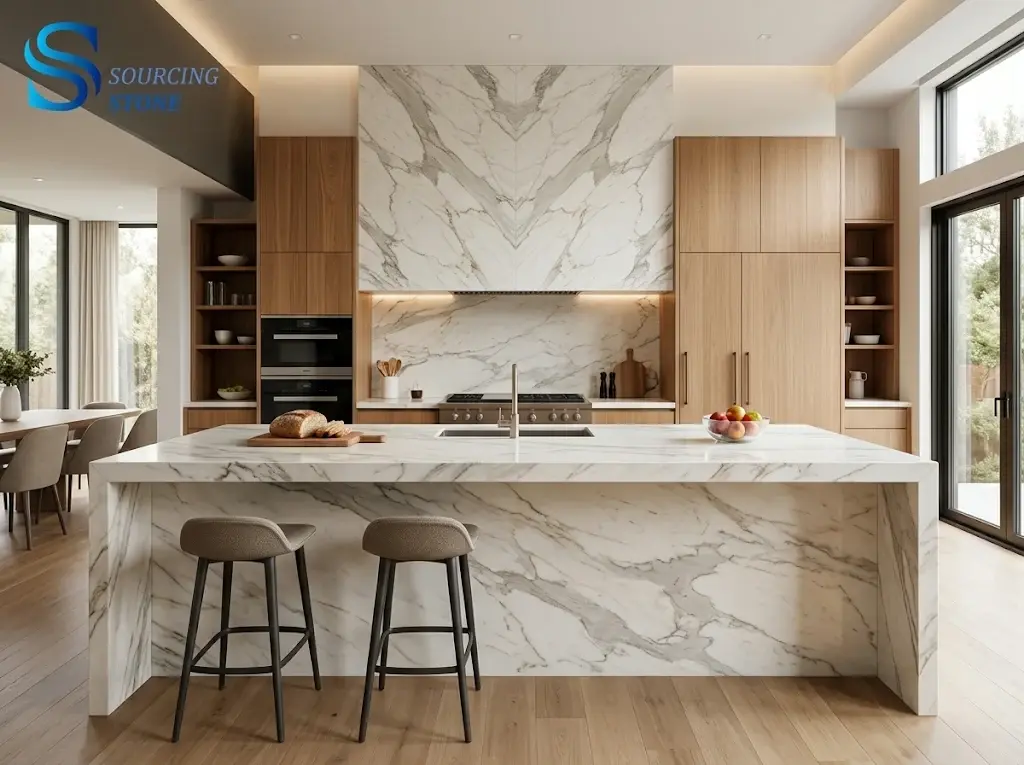
The most important visual factors are background whiteness, vein direction, vein thickness, pattern density, and the overall balance of the slab. Some selections have a relatively clean white background with widely spaced grey veins. Others feature dramatic diagonal movements or warmer gold-colored details.
These differences affect how the material works within an interior. A slab with bold, high-contrast veins may create a strong focal point on a kitchen island or reception counter. A selection with softer grey movement may be more suitable for large wall surfaces or projects requiring a quieter visual effect.
Natural variation should be considered part of the material-selection process. It is not automatically a defect. The important distinction is between acceptable geological characteristics and conditions that may affect fabrication, installation, structural performance, or the intended appearance.
Why Is Calacatta Marble Popular in Premium Projects?
Calacatta White Marble offers a combination of natural pattern variation, a bright visual background, and a distinctive appearance that can be difficult to reproduce exactly with other materials. It can complement contemporary minimalism, classic interiors, transitional spaces, and luxury hospitality design.
Its growing use is also connected to the demand for large-format natural surfaces, statement islands, bookmatched walls, and materials with visible geological character. Designers can use a single slab as a focal element or coordinate several slabs to create a continuous visual composition.
For a more focused discussion of its design appeal and market demand, buyers can explore why Calacatta White Marble is becoming increasingly popular in residential and commercial interiors.
Identify the Right Calacatta Marble Vein Pattern for Your Project
Bold and Dramatic Vein Patterns
Bold-veined Calacatta selections are often chosen for kitchen islands, hotel reception desks, luxury retail counters, and feature walls. Their strong visual movement can make a large surface feel more individual and visually engaging.
However, dramatic patterns require careful slab planning. If the project uses multiple slabs, the designer should review the vein direction and pattern transitions before fabrication. A visually attractive individual slab may not automatically produce a balanced result when installed beside another slab with a different pattern.
Soft Grey and Subtle Vein Patterns
Subtle grey-veined selections provide a more restrained appearance. They can work well in bathrooms, residential flooring, wall cladding, and spaces where the marble should support the overall interior rather than dominate it.
For large projects, consistency in background tone and vein intensity may be more important than selecting the most dramatic individual slab. Buyers should request photographs of the complete available batch and confirm the acceptable range of natural variation.
Gold and Warm-Toned Vein Patterns
Gold and warm-toned veins can complement brass hardware, warm wood, champagne-colored metal finishes, and beige interior palettes. They are frequently considered for luxury hospitality projects and residential spaces with warm neutral color schemes.
Because warm-colored veins can vary significantly between blocks, buyers should confirm whether the selected slabs have the desired level of gold, brown, or rust-colored movement. A generic reference photograph may not accurately represent the material that will be delivered.
How to Match Vein Direction with Interior Design
Vein direction should be evaluated in relation to the dimensions and orientation of the finished surface. Horizontal movement can visually extend a countertop or wall, while diagonal veins may create a more dynamic composition. Bookmatching can produce a symmetrical effect when two adjacent slabs are selected and fabricated correctly.
Before production, prepare a slab layout showing the intended position of each piece. Include sink cutouts, cooktop openings, corners, edges, wall returns, and visible joints. This step helps prevent an attractive vein from being interrupted by an unexpected cutout or an unsuitable joint position.
Choose the Correct Slab Size and Thickness for Different Applications
Common Calacatta White Marble Slab Sizes
Slab dimensions depend on the original block, processing equipment, product availability, and supplier inventory. Large-format slabs can reduce the number of visible joints on kitchen islands and feature walls, but they also create additional handling, transportation, and installation considerations.
Buyers should confirm actual slab length, width, thickness, and usable area rather than assuming that all slabs sold under the same product name have identical dimensions. Measurements should also be checked against the fabrication drawings and site access conditions.
20 mm vs. 30 mm Calacatta Marble Slabs
Two commonly discussed thickness options for marble applications are 20 mm and 30 mm. These are selection references rather than universal requirements. Availability, structural design, edge details, support conditions, and local building specifications determine which thickness is appropriate.
| Selection Factor | 20 mm Slab | 30 mm Slab |
|---|---|---|
| Nominal Thickness | 20 mm | 30 mm |
| Typical Design Direction | Wall cladding, vanity tops, selected countertops | Countertops, islands, and applications requiring a thicker visual edge |
| Material Weight | Lower per unit area than 30 mm | Higher per unit area than 20 mm |
| Fabrication Considerations | Support and edge details must be engineered | Greater material thickness, but still requires proper support and handling |
| Purchasing Considerations | Check actual thickness and tolerance | Check actual thickness, weight, and transportation requirements |
A thicker slab should not automatically be treated as suitable for every demanding application. The performance of a finished installation also depends on stone characteristics, support spacing, fixing systems, cutout design, fabrication quality, and installation workmanship.
How to Calculate Slab Requirements and Material Yield
Accurate quantity planning is particularly important for projects involving large islands, continuous wall panels, bookmatched surfaces, or multiple rooms. Buyers should calculate the required finished area and then consider cutting layout, edge profiles, vein matching, defects, and reserve material.
For example, a project requiring 12 square meters of finished marble does not necessarily need exactly 12 square meters of raw slab area. The final quantity depends on slab dimensions and how efficiently the individual pieces can be arranged. Complex patterns, large cutouts, and bookmatching may increase material consumption.
A practical procurement process should include:
- Confirming the final fabrication drawings and finished dimensions.
- Reviewing the dimensions of each available slab.
- Identifying areas where vein continuity or bookmatching is required.
- Allowing for cutting loss and unavoidable material variation.
- Confirming whether reserve slabs from the same batch are available.
Select the Right Surface Finish for Residential and Commercial Applications
Polished Calacatta White Marble
Polished marble has a reflective surface that enhances the visual contrast between the background and the veins. It is frequently selected for feature walls, vanity tops, decorative countertops, and interiors where a refined appearance is important.
Its reflective quality can make a room feel brighter, but polished marble may show scratches, etching, water marks, or surface wear under certain conditions. It should not be selected solely because it looks attractive in a showroom. The expected use, cleaning routine, and maintenance capacity should also be considered.
Honed Calacatta White Marble
Honed marble has a matte or low-sheen appearance. It can create a softer visual effect and is often considered for contemporary residential interiors, bathroom surfaces, and selected commercial applications.
A honed finish does not make marble stain-proof or acid-resistant. It may also show certain marks differently from polished marble. Buyers should request a finish sample and evaluate it under lighting conditions similar to the completed project.
Brushed, Leathered, and Other Specialty Finishes
Specialty finishes can introduce a more tactile appearance, but availability and consistency depend on the stone and processing method. A finish that works well on one marble variety may not produce the same result on another.
For large-volume orders, buyers should confirm the finish specification, sample approval procedure, and acceptable visual tolerance. The approved sample should be used as a reference during production and quality inspection.
| 표면 마감 | 모양 | Potential Applications | Key Consideration |
|---|---|---|---|
| 광택 | Glossy and reflective | Feature walls, vanity tops, selected countertops | Etching and surface marks may be more visible |
| 연마 | Matte or low-sheen | Bathrooms, contemporary interiors, selected flooring | Still requires suitable cleaning and maintenance |
| Brushed | Textured and less reflective | Decorative surfaces and selected design applications | Confirm texture consistency and cleaning requirements |
| 가죽 | Tactile surface with varied light reflection | Selected countertops and feature surfaces | Availability and suitability depend on the stone |
How to Choose Calacatta White Marble for Residential Projects
주방 조리대 및 아일랜드
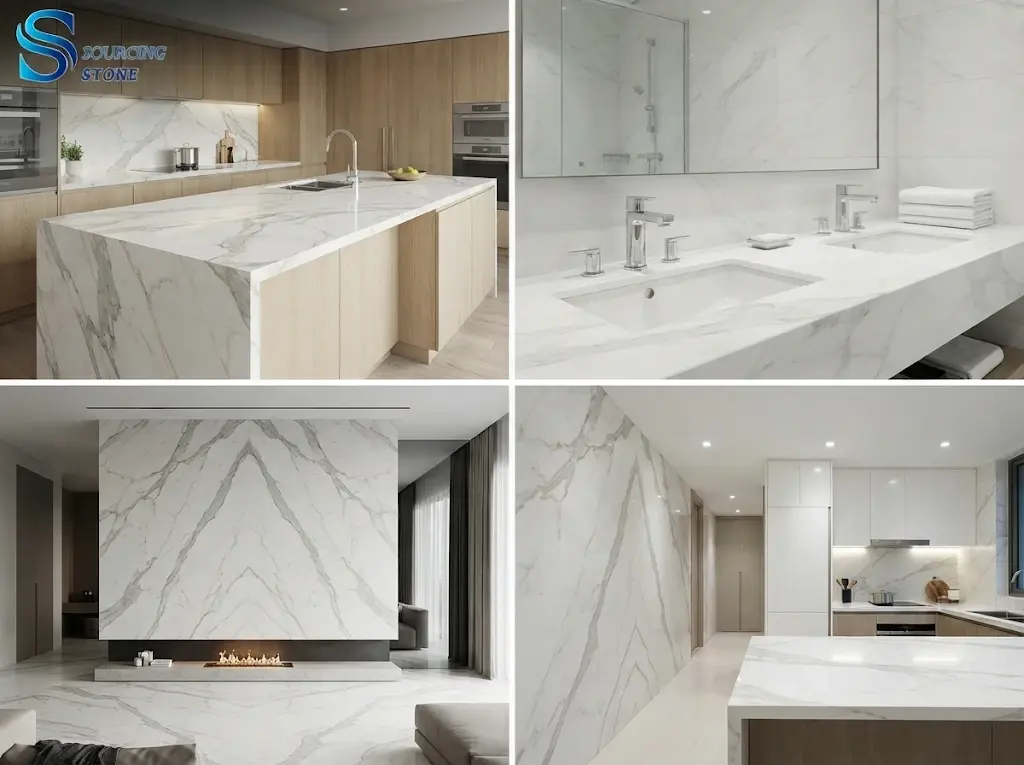
Calacatta White Marble can create a distinctive kitchen island or countertop, especially when the vein pattern is selected to coordinate with cabinetry, flooring, splashbacks, and metal fixtures. Large islands provide an opportunity to display a continuous section of the natural pattern.
However, marble is a calcium-carbonate-based natural stone and can react with acidic substances. Lemon juice, vinegar, wine, and some household cleaners may etch the surface. Etching is a chemical surface change rather than simply a stain, and it may require professional refinishing to correct.
For a busy kitchen, buyers should consider how frequently the surface will be used, whether the household accepts natural patina, and how consistently the stone will be maintained. If low maintenance and resistance to everyday acids are the highest priorities, it may be appropriate to compare natural marble with engineered or porcelain alternatives before making a final decision.
욕실 세면대 및 샤워 벽
Calacatta marble is often used for vanity tops, wall panels, and decorative bathroom surfaces. Its light background can create a clean visual effect, while the veins provide contrast against glass, metal, wood, and ceramic elements.
Wet-area applications require attention to substrate preparation, waterproofing, drainage, fixing systems, and suitable surface treatment. Marble itself should not be treated as a substitute for a complete waterproofing system. For shower floors and other frequently wet surfaces, the finish, slope, joint design, and slip-related requirements should be evaluated by the project team.
Living Rooms and Feature Walls
Large marble panels can become a focal point in living rooms, fireplace surrounds, entrance halls, and feature walls. Bookmatched slabs are especially useful when a symmetrical visual composition is required.
Before ordering, confirm panel dimensions, installation weight, fixing details, and the wall’s structural capacity. Large natural stone panels require suitable mechanical or adhesive fixing systems designed for the specific project conditions.
Luxury Residential Developments
For multi-unit residential projects, consistency and supply planning are often more important than selecting one visually exceptional slab. Developers should define a reference sample, acceptable color range, finish, thickness, and inspection procedure before production begins.
It is also useful to confirm whether replacement material can be sourced later. Natural stone from a different block or production period may not match the original installation exactly. Reserving additional material from the same batch can reduce this risk.
How to Select Calacatta White Marble for Commercial Projects
Hotels and Hospitality Interiors
Hotels use natural marble in reception counters, lobby walls, bathroom vanities, elevator surrounds, and selected public areas. In these environments, the stone must satisfy both design expectations and operational requirements.
High-visibility areas may benefit from bold vein patterns, while corridors and larger wall surfaces may require a more consistent visual direction. Maintenance schedules, cleaning products, replacement planning, and installation access should be considered during material selection.
Offices and Corporate Buildings
Calacatta marble can be used in reception areas, executive spaces, meeting-room feature walls, and decorative interior elements. For office projects, buyers should balance the desired premium appearance with the frequency of use and the building’s maintenance arrangements.
For flooring in heavily trafficked areas, the project team should review abrasion-related performance, finish suitability, slip resistance requirements, and cleaning procedures. A polished finish may not be the best choice for every public floor.
Retail Stores and Luxury Showrooms
Retail environments often use marble to communicate a premium brand image. Countertops, display plinths, wall panels, and product presentation areas can benefit from carefully selected natural patterns.
Since display lighting can change how white backgrounds and grey or gold veins appear, final approval should ideally take place under representative lighting. Buyers should also inspect the material at the viewing distance and orientation expected in the finished store.
Large Commercial Stone Project Requirements
Commercial orders require a more formal procurement process than many small residential purchases. A reliable supplier should be able to discuss slab availability, batch identification, processing capacity, packing methods, inspection records, and delivery coordination.
For international buyers, it is useful to review the supplier’s production and export experience, quality-control procedures, and ability to coordinate customized stone requirements. A clear overview of the stone supplier’s manufacturing and export capabilities can help purchasing teams understand the company’s product range and project-support background.
Before confirming an order, establish written acceptance criteria. These should cover dimensions, thickness tolerance, finish, visible repairs, acceptable natural variation, packaging, labeling, and the procedure for handling damaged or non-conforming pieces.
Calacatta White Marble vs. Carrara Marble vs. Statuario Marble
Calacatta vs. Carrara
Calacatta and Carrara are both well-known white marble categories, but they are commonly selected for different visual directions. Calacatta is often associated with a brighter background and more prominent vein patterns, while Carrara is frequently recognized for softer grey veining and a more understated appearance.
These are broad visual distinctions rather than absolute rules. Natural stone varies between blocks, and individual selections may not follow a simplified category description. The actual slab should always be reviewed before purchase.
Calacatta vs. Statuario
Statuario marble is also associated with a light background and distinctive veining. Depending on the specific material, its appearance can overlap with certain Calacatta selections. Buyers should compare background tone, vein structure, availability, block consistency, and the actual finished-slab appearance rather than making a decision based only on the commercial name.
For a more detailed comparison, review the differences between White Carrara and Calacatta Marble when deciding which visual direction better suits the project.
| Comparison Factor | 칼라카타 대리석 | 카라라 대리석 | 스테이터리오 마블 |
|---|---|---|---|
| Common Background Direction | White to creamy white | White to light grey | White to bright white |
| Common Vein Appearance | Often bold or expressive | Often softer and more distributed | Often prominent and defined |
| Design Character | Statement and contrast | Classic and understated | Refined and dramatic |
| Typical Design Uses | Islands, feature walls, vanities | Bathrooms, floors, countertops | Feature surfaces and premium interiors |
| Selection Priority | Vein pattern and background tone | Overall consistency and subtle movement | Pattern quality and slab availability |
This comparison describes common market perceptions and design tendencies. It is not a geological grading system, a guarantee of origin, or a substitute for inspecting the actual slabs and technical documentation.
Material Fit by Product Direction: Matching the Surface to the Application
Choosing a marble-look surface is not simply a question of appearance. Natural marble, engineered quartz, and porcelain slabs have different compositions, fabrication requirements, maintenance characteristics, and application limits. A product that works well for a decorative wall may not be the most suitable choice for a heavily used kitchen or a high-traffic commercial floor.
The following matrix is an application-fit guide, not statistical data. It does not represent measured probabilities, guaranteed performance, or universal suitability. Actual selection depends on the specific product specification, thickness, finish, fabrication method, support system, installation environment, and project requirements.
Legend:
- ●●● = Primary
- ●●○ = Strong Option
- ●○○ = Depends on Workflow
- — = Usually Not First Choice
| Product Direction | Kitchen Island | Bathroom Vanity | Feature Wall | Commercial Flooring |
|---|---|---|---|---|
| 칼라카타 화이트 대리석 | ●●● | ●●○ | ●●● | ●○○ |
| 칼라카타 골드 마블 | ●●● | ●●○ | ●●● | ●○○ |
| 화이트 카라라 대리석 | ●●○ | ●●● | ●●○ | ●●○ |
| Calacatta-Style Engineered Quartz | ●●● | ●●● | ●●○ | ●○○ |
| Calacatta-Style Porcelain Slabs | ●●○ | ●●● | ●●● | ●●○ |
How to interpret the matrix: Natural Calacatta marble is a strong design option for statement islands and feature walls, but kitchen users must accept the maintenance needs of a calcareous natural stone. Carrara marble may suit projects that prefer softer visual movement. Engineered quartz and porcelain products can provide alternative design directions, but their composition, heat resistance, edge fabrication, repairability, and installation requirements must be checked against the manufacturer’s technical documentation.
Do not assume that a product described as Calacatta quartz or Calacatta porcelain is natural marble. The word Calacatta may describe a visual pattern in manufactured materials. Buyers should confirm the actual material category before comparing technical data or maintenance expectations.
How to Evaluate Calacatta White Marble Slab Quality Before Purchasing
Background Color and Vein Distribution
Inspect the entire slab under neutral lighting. Look for the overall background tone, vein density, vein direction, and visible color variation. A small sample may show the general color but cannot represent the complete pattern of a large slab.
For projects requiring multiple slabs, compare them side by side whenever possible. This is particularly important for kitchen islands, hotel lobbies, and bookmatched wall installations where visual transitions are easy to notice.
Natural Fissures, Cracks, and Surface Repairs
Natural marble may contain geological features such as veins, fissures, and filled areas. Their presence does not automatically make a slab unacceptable. The relevant question is whether the feature affects the intended use, fabrication process, appearance, or structural requirements.
Buyers should distinguish between natural veining, filled fissures, resin treatment, and cracks that may compromise the finished component. Any repairs or treatments should be disclosed and evaluated against the agreed quality criteria.
Flatness, Thickness, and Dimensional Tolerance
Slab inspection should include thickness measurements at multiple points, edge condition, flatness, and dimensional accuracy. Inconsistent thickness can complicate fabrication and installation, particularly when several slabs must align at joints or meet other materials.
Acceptance tolerances should be stated in the purchase specification. Avoid relying on informal descriptions such as premium quality or export quality without defining what those terms mean for the project.
Full-Slab Photos and Batch Information
Request clear photographs of the actual slabs, including full-length images and close-ups of areas with notable veins, fissures, or repairs. Each slab should be identifiable through a reference number or batch record.
For large orders, keep approved photographs and samples as part of the purchase documentation. This creates a reference for pre-shipment inspection and helps reduce misunderstandings about natural variation.
Approve Samples Before Mass Production or Installation
Sample approval should cover more than color. Confirm finish, thickness, edge treatment, surface condition, and the acceptable range of natural variation. If the final application involves a large visible surface, approve the actual slabs or a representative production batch whenever possible.

Bookmatching, Slab Layout, and Fabrication Planning
What Is Bookmatched Calacatta Marble?
Bookmatching is a layout method in which two adjacent slabs are opened or positioned to create a mirrored visual pattern. It is often used for feature walls, fireplace surrounds, hotel reception backgrounds, and large decorative panels.
The result depends on the original vein structure, slab sequence, cutting direction, and fabrication accuracy. Not every marble block produces a suitable bookmatch. Buyers should confirm that the selected slabs are consecutive or otherwise specifically matched for the intended composition.
Vein Continuity and Cutting Layout
Before cutting, prepare a digital or physical layout showing how the slabs will be divided into finished pieces. Mark the direction of the veins and identify the visible edges, joints, and cutouts. This helps the fabricator use the material more efficiently while preserving the intended pattern.
Reducing Material Waste and Fabrication Risk
Material waste can increase when the design includes oversized islands, narrow returns, irregular shapes, large sink openings, or strict vein-matching requirements. A detailed cutting plan should be prepared before the final quantity is confirmed.
Fabricators should also review the stone’s natural features before cutting. A vein or fissure that appears harmless in a full slab may become important when positioned close to a narrow edge or cutout. Early communication between the buyer, designer, supplier, and fabricator reduces the risk of avoidable rework.
Calacatta Marble Maintenance, Sealing, and Long-Term Performance
Does Calacatta White Marble Need to Be Sealed?
Sealing requirements depend on the specific marble, surface finish, installation location, and selected treatment product. An impregnating sealer can improve resistance to certain stains, but it does not make natural marble completely stain-proof or acid-proof.
Before applying a sealer, consult the stone supplier and the treatment manufacturer’s instructions. For food-preparation surfaces, confirm that the selected product is suitable for the intended use and follow the applicable product guidance.
How to Clean and Maintain Calacatta Marble
Routine maintenance should use a neutral stone cleaner or a mild cleaning solution recommended for natural stone. Clean spills promptly, rinse away cleaning residue, and dry the surface with a soft cloth when appropriate. Use protective mats or boards in areas exposed to frequent food preparation or heavy use.
Acidic products such as vinegar, lemon juice, and some bathroom cleaners can dull or etch marble surfaces. Abrasive powders and unsuitable cleaning pads may also damage the finish. Always test an unfamiliar cleaning product in a discreet area and follow the stone-care recommendations.
Common Maintenance Mistakes
- Using vinegar or acidic cleaners on marble.
- Assuming that sealing makes the surface completely stain-proof.
- Leaving acidic spills on the surface for extended periods.
- Using abrasive pads without confirming surface compatibility.
- Applying a cleaning or sealing product without checking its suitability for the stone.
- Ignoring moisture management, joints, or installation-related problems.
For commercial properties, a written maintenance plan is useful. It should identify approved cleaning products, daily cleaning procedures, periodic inspection requirements, and the process for addressing stains, etching, or physical damage.
Technical Specifications, Quality Standards, and Project Compliance
Which Technical Properties Should Buyers Check?
Natural marble should be evaluated using test methods appropriate to the stone type and intended application. A product description or visual inspection alone cannot establish its complete physical performance.
For project specifications, buyers may request test reports covering water absorption, bulk specific gravity, compressive strength, flexural strength, and abrasion resistance where relevant. The results should identify the tested material and the method used.
| Technical Property | Relevant Test Method | Why It Matters | Buyer Action |
|---|---|---|---|
| Water Absorption and Bulk Specific Gravity | ASTM C97/C97M | Helps evaluate physical characteristics related to moisture and density | Request a report for the specified material |
| 압축 강도 | ASTM C170/C170M | Provides information about resistance to compressive loading | Compare results with project design requirements |
| 굴곡 강도 | ASTM C880/C880M | Helps evaluate stone performance under bending conditions | Consider panel dimensions, support, and loading direction |
| 내마모성 | ASTM C241/C241M or applicable method | Relevant to selected flooring and foot-traffic applications | Check suitability for the expected traffic level |
| Material Specification | ASTM C503/C503M | Provides a specification framework for marble dimension stone | Confirm the applicable classification and project requirements |
Important technical note: The table identifies relevant standards and test purposes; it does not provide universal performance values for Calacatta White Marble. Actual results vary by stone source, block, specimen preparation, and test conditions. Buyers should request product-specific laboratory reports and confirm the current applicable edition of each standard.
Quality Standards and Commercial Project Documentation
ASTM C503/C503M is a relevant specification for marble dimension stone, while ASTM C97/C97M, C170/C170M, and C880/C880M address specific physical testing properties. The project specification should identify which tests are required, the acceptance criteria, and the sampling procedure.
For commercial installations, the technical review should also consider panel dimensions, fixing systems, substrate conditions, structural loading, wet or dry installation conditions, and local building requirements. A material test report does not replace engineering review of the completed assembly.
Worker Safety and Regulatory Considerations
Stone fabrication and installation can generate airborne dust during cutting, grinding, drilling, and polishing. Marble is generally a calcium-carbonate-based stone with substantially lower crystalline silica content than many quartz-rich materials, but workers still need appropriate dust controls and safe work procedures.
In the United States, employers must evaluate applicable occupational safety requirements, including OSHA’s respirable crystalline silica standards where relevant. Requirements differ between general industry and construction activities. Wet processing, local exhaust ventilation, exposure assessment, training, housekeeping, and suitable protective equipment may form part of an effective safety program.
For international projects, buyers and contractors should also check local workplace safety regulations, building codes, fire and material requirements where applicable, and any project-specific documentation obligations. Compliance should be assessed for the actual work process and destination market rather than assumed from a general product description.
Calacatta Marble Price Factors and Wholesale Purchasing Considerations
What Influences Calacatta White Marble Prices?
The price of Calacatta White Marble depends on several connected factors. These may include the stone’s source, background color, vein pattern, block quality, slab dimensions, thickness, finish, processing requirements, usable yield, packaging, transportation, and order volume.
Slabs with a highly desirable visual pattern or limited availability may command a different price from more commonly available selections. Large-format slabs, bookmatched pairs, customized dimensions, and special finishes can also affect the final quotation.
Buyers should compare quotations on a consistent basis. A low unit price may not represent the best total purchasing value if it excludes required processing, protective packaging, inspection, or additional material needed for pattern matching.
How to Compare Marble Suppliers and Manufacturers
When evaluating a Calacatta marble supplier 또는 marble manufacturer, purchasing teams should review more than the product catalogue. Important considerations include material availability, production capability, quality-control procedures, export experience, communication, and the ability to support customized project requirements.
For wholesale orders, confirm whether the supplier can provide actual slab photographs, batch references, dimensional information, test documentation where available, and clear packing details. Ask how the company handles natural variation, inspection findings, and replacement requests.
Wholesale Ordering Checklist
- Confirm the exact stone type and product reference.
- Approve the actual slab appearance or representative batch.
- Specify slab dimensions, thickness, finish, and tolerances.
- Identify acceptable natural features and unacceptable defects.
- Confirm the required quantity and cutting allowance.
- Review packaging, loading, and transportation arrangements.
- Agree on inspection procedures and documentation.
- Confirm delivery schedules and communication responsibilities.
A structured purchase specification makes it easier to compare different suppliers and reduces the risk of disputes caused by unclear expectations. For large residential developments and commercial projects, this process should be completed before production or final order confirmation.
2026 Trends in Calacatta White Marble for Residential and Commercial Design
Large-Format Natural Marble Surfaces
Large-format stone surfaces remain an important design direction in premium interiors. Designers use larger panels to reduce visual interruptions and create more continuous patterns across islands, walls, and reception areas. This approach requires careful planning of slab dimensions, handling equipment, support systems, and installation access.
Natural Veining and Bookmatched Feature Surfaces
Interest in natural variation continues to support the use of expressive marble patterns. Bookmatched installations can turn a natural vein structure into a central design feature. However, the quality of the result depends on the actual slab sequence and fabrication layout, not simply on choosing a marble category.
Warm Minimalism and Mixed Materials
Calacatta marble can be combined with warm wood, brushed metal, textured paint, neutral cabinetry, and other natural materials. Warm-toned veins may support brass or champagne-colored details, while grey veins can complement cooler metals and minimalist palettes.
Responsible Sourcing and Material Traceability
Project buyers increasingly need clear information about material origin, production, packaging, and supplier documentation. Responsible procurement is not limited to a sustainability statement. It also involves understanding the supply chain, reducing unnecessary waste, planning material quantities carefully, and requesting relevant documentation.
For natural stone projects, a practical approach is to balance visual quality, technical suitability, expected service life, and the resources required for fabrication and maintenance.

Frequently Asked Questions About Calacatta White Marble Slabs
1. What Is the Difference Between Calacatta White Marble and Carrara Marble?
Calacatta White Marble is commonly selected for its bright background and more expressive grey or gold veining, while White Carrara Marble is often associated with softer grey patterns and a more understated appearance. However, natural marble varies from block to block, so these descriptions are general visual tendencies rather than strict rules. Buyers should compare actual slabs, background color, vein distribution, dimensions, and availability before choosing a material for a specific project.
2. Is Calacatta White Marble Suitable for Kitchen Countertops?
Yes. Calacatta White Marble can be used for kitchen countertops and islands when the design, fabrication, installation, and maintenance requirements are properly considered. It provides a distinctive natural appearance, but marble can be etched by acidic substances such as lemon juice and vinegar. It may also stain if spills are not managed appropriately. Homeowners should understand the maintenance requirements, use suitable cleaning products, and discuss sealing and surface protection with their stone supplier and fabricator before installation.
3. What Is the Best Thickness for Calacatta White Marble Slabs?
There is no single thickness that is best for every Calacatta marble application. Slabs around 20 mm and 30 mm are common thickness options discussed for countertops, islands, vanities, and other interior surfaces, but actual availability and suitability depend on the product and project. Buyers should consider finished dimensions, support conditions, edge details, structural requirements, handling, and installation methods. The fabricator or project engineer should confirm the required thickness based on the intended application rather than relying on appearance alone.
4. Does Calacatta White Marble Need to Be Sealed?
Sealing may be recommended depending on the marble’s absorption characteristics, finish, installation location, and expected use. An appropriate impregnating sealer can improve resistance to certain stains, but it does not make marble completely stain-proof or protect it from acid etching. Buyers should ask the supplier or stone-care professional whether sealing is appropriate for the selected material and how frequently the treatment should be reviewed. Cleaning products should also be compatible with natural marble.
5. How Do You Choose Calacatta Marble Slabs for Large Commercial Projects?
Large commercial projects require a structured selection and procurement process. Buyers should review the full slab appearance, background consistency, vein direction, thickness, finish, dimensional tolerance, natural fissures, and any surface repairs. They should also confirm batch availability, cutting layouts, bookmatching requirements, technical test documentation, packaging, and delivery arrangements. A written specification and approved slab reference help align the supplier, designer, fabricator, and installation team. For high-traffic applications, the project team should also evaluate maintenance needs, finish suitability, and relevant technical and regulatory requirements.
References
- ASTM International. Standard Specification for Marble Dimension Stone, ASTM C503/C503M. ASTM Committee C18 on Dimension Stone.
- ASTM International. Standard Test Methods for Absorption and Bulk Specific Gravity of Dimension Stone, ASTM C97/C97M. ASTM Committee C18 on Dimension Stone.
- ASTM International. Standard Test Method for Compressive Strength of Dimension Stone, ASTM C170/C170M. ASTM Committee C18 on Dimension Stone.
- ASTM International. Standard Test Method for Flexural Strength of Dimension Stone, ASTM C880/C880M. ASTM Committee C18 on Dimension Stone.
- Natural Stone Institute. Which ASTM Standards Are Relevant to Natural Stone? Natural Stone Institute, Design Professionals Resources.
- Natural Stone Institute. Care and Cleaning of Natural Stone. Natural Stone Institute, Consumer Resources.
- Occupational Safety and Health Administration (OSHA). Silica, Crystalline: Overview and Occupational Exposure Standards. U.S. Department of Labor.
- National Institute for Occupational Safety and Health (NIOSH) and Occupational Safety and Health Administration (OSHA). Worker Exposure to Silica during Countertop Manufacturing, Finishing, and Installation. DHHS (NIOSH) Publication No. 2026-101, 2026.
Final Considerations: Choosing Calacatta White Marble with Confidence
Selecting Calacatta White Marble is a process of matching natural appearance with real project requirements. A successful choice considers the background tone, vein pattern, slab dimensions, thickness, surface finish, fabrication plan, installation environment, maintenance expectations, and total procurement cost.
For residential buyers, the main decision is often how the marble will look and perform in daily use. For commercial developers, consistency, technical documentation, supply capacity, installation coordination, and long-term maintenance can be equally important. Neither group should rely only on a product name, a small sample, or a low initial quotation.
Before placing an order, request actual slab photographs, confirm the batch and specifications, review relevant test reports, and agree on inspection and acceptance criteria. If the project involves multiple slabs or bookmatching, complete the layout before cutting begins.
Working with an experienced Calacatta marble supplier can help buyers coordinate material selection, processing, quality checks, and export arrangements. Share the intended application, approximate dimensions, preferred pattern, finish, thickness, and project quantity when requesting a quotation. This gives the supplier a clearer basis for recommending suitable slab options and preparing a more accurate proposal.
How to Make a Better Calacatta White Marble Selection: Material Insights and Project Decisions
How should buyers choose Calacatta White Marble? Start by defining the intended application, visual direction, slab dimensions, thickness, finish, and maintenance expectations. Compare full slabs rather than relying on small samples, and confirm that the selected material can meet the project’s fabrication and installation requirements.
Why do projects choose Calacatta White Marble? Its bright background and natural grey or gold veining can create distinctive surfaces in kitchens, bathrooms, hotel interiors, reception counters, and feature walls. The stone is particularly useful when the natural pattern is intended to contribute directly to the interior design. Its appeal should nevertheless be balanced against the maintenance characteristics of natural marble.
What should be evaluated before purchasing? Buyers should review the actual slab appearance, background consistency, vein distribution, natural fissures, repairs, thickness, dimensional tolerance, surface finish, and available technical documentation. For multi-slab projects, batch consistency and reserve material are important because natural stone patterns cannot be reproduced exactly.
Which material options should be considered? Natural Calacatta White Marble is a strong option for projects prioritizing authentic geological patterns. Carrara marble offers another natural white-marble direction, often with softer grey movement. Engineered quartz and porcelain slabs can provide Calacatta-inspired appearances with different material compositions and performance characteristics. These alternatives should be compared through their own technical specifications rather than treated as identical products.
What are the most important purchasing considerations? The lowest slab price does not always produce the lowest project cost. Cutting yield, bookmatching, fabrication complexity, packaging, transportation, installation, maintenance, and replacement availability all influence total value. A clear purchase specification, approved slab photographs, written acceptance criteria, and a realistic cutting plan help reduce avoidable risks.
How are project requirements changing? Large-format panels, expressive natural veining, bookmatched feature walls, warm minimalism, and more transparent sourcing information continue to influence premium stone selection. At the same time, commercial buyers need to consider worker safety, local building requirements, installation engineering, and long-term maintenance. A responsible selection process connects visual design with technical evidence and practical project management.
Practical decision: Choose Calacatta White Marble when its natural appearance, project suitability, and maintenance requirements align with the design brief. Confirm the actual slabs and technical details before production, then coordinate the supplier, fabricator, and installation team around one approved specification. This approach supports more predictable purchasing decisions for both residential and commercial stone projects.