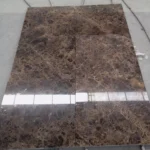
Yes, White Wooden Marble Slab can be used in wet areas when the stone finish, installation method, and maintenance requirements are properly considered. It is well suited to bathroom wall cladding, vanity tops, and bathroom floors exposed to occasional moisture. For shower floors and areas with frequent water contact, the selection requires greater care. A suitable honed or textured finish, an appropriate penetrating sealer, and a properly installed waterproofing system beneath the stone are essential considerations. Actual slip resistance and moisture performance should also be verified for the intended application.
What Makes White Wooden Marble Slab Suitable for Wet Areas?
White Wooden Marble Slab is a natural marble known for its distinctive linear veining, which resembles wood grain across a milky white to soft gray background. It is also marketed under trade names such as Georgette Marble and Silk Georgette, although naming conventions and stone characteristics can vary by supplier and quarry. Its soft color palette and flowing grain pattern make it a popular option for bathroom wall cladding, vanity tops, and spa-inspired interiors.
However, appearance alone does not determine whether a marble slab is suitable for wet areas. Its performance depends on physical properties such as water absorption, density, mineral composition, and surface finish. As a metamorphic rock, marble can vary considerably between quarries and individual blocks. ASTM C97/C97M provides standardized methods for measuring water absorption and bulk specific gravity, helping buyers evaluate the physical properties of a particular stone lot before specifying it for a project.

Water Absorption, Density, and Other Physical Properties
Available supplier specifications for White Wooden Marble Slab may report different physical values depending on the quarry, block, and testing conditions. The following figures should therefore be treated as preliminary reference values rather than universal product specifications:
- Water absorption: Some published specifications report values around 0.35%–0.46%, but actual results should be confirmed through batch-specific testing.
- Densidade: Reported values can vary, with some supplier data falling within approximately 2.55–2.70 g/cm³.
- Compressive strength: Some published product specifications report values around 108–110 MPa. Buyers should verify whether the figures represent dry or wet test conditions.
- Available finishes: Common options include polished, honed, and selected textured finishes, subject to supplier availability.
These properties help buyers assess the suitability of White Wooden Marble Slab for different architectural applications. However, a relatively low water absorption rate does not make natural marble waterproof. Repeated moisture exposure, standing water, cleaning products, and installation conditions can all affect long-term performance. For this reason, project specifications should be based on actual material test reports rather than general figures associated with a stone’s trade name.
The following table provides a practical overview of where White Wooden Marble Slab may be considered for wet-area applications. Final suitability depends on the selected finish, project conditions, and installation system.
| Application Zone | Suitability | Key Considerations |
|---|---|---|
| Bathroom wall cladding | Generally suitable | Limited standing-water exposure; proper sealing and waterproofing behind the stone remain important |
| Vanity tops and sink surrounds | Generally suitable | Requires appropriate sealing and prompt removal of standing water, cosmetics, and acidic products |
| General bathroom floors | Conditional | Select a suitable surface finish and verify slip-resistance performance for the intended use |
| Walk-in shower floors | Requires careful evaluation | Consider barefoot slip resistance, tile dimensions, grout joints, drainage, and waterproofing |
| Steam shower interiors | Project-dependent | Repeated heat and moisture exposure require careful material selection, installation, and maintenance |
| Pool decks and continuously wet outdoor areas | Requires specialized assessment | Consider prolonged water exposure, slip resistance, weathering, and the suitability of the selected stone finish |
How the Wood-Grain Pattern Influences Bathroom Design
The linear veining of White Wooden Marble Slab offers more than decorative appeal. Its directional pattern influences slab selection, cutting layouts, and bookmatching arrangements, particularly in bathrooms where large stone surfaces are intended to create visual continuity.
When the grain runs horizontally across a bathroom wall, it can emphasize the width of the space. Large-format marble panels can also create a more continuous architectural appearance than smaller individual tiles. Bookmatched slabs provide another design option, allowing adjacent panels to form symmetrical or mirrored vein patterns.
For stone fabricators, designers, and project buyers, these visual details should be considered before slab cutting begins. Selecting blocks with compatible veining, confirming slab dimensions, and planning the installation sequence can help reduce pattern mismatches and unnecessary material waste. This is particularly important for bathroom wall cladding, vanity backsplashes, and other applications where the natural grain is a central part of the design.
Which Surface Finish Works Best for Wet Areas?
Surface finish is an important factor when selecting White Wooden Marble Slab for bathrooms and other moisture-exposed spaces. Polished, honed, and textured finishes differ in appearance, surface characteristics, cleaning requirements, and potential slip resistance. Choosing the right finish requires considering where the marble will be installed and how frequently the surface will come into contact with water.
Polished Marble for Bathroom Walls and Vanity Tops
Polished White Wooden Marble Slab has a smooth, reflective surface that highlights its white background and distinctive wood-grain veining. This finish is particularly suitable for bathroom wall cladding, vanity tops, and backsplashes, where its glossy appearance can enhance the visual depth of the natural stone.
However, polished marble requires more careful consideration on floors. When water, soap, or cleaning residue forms a film on a smooth stone surface, the risk of slipping can increase. A polished finish should therefore not be assumed suitable for floors exposed to regular moisture. Buyers and project specifiers should request relevant slip-resistance information and assess whether the selected material meets the requirements of its intended application.
Honed Marble for Bathroom Flooring
Honed marble has a matte or low-sheen surface produced through mechanical finishing rather than the high-gloss polishing process. It retains the natural grain and color variation of White Wooden Marble Slab while offering a different surface texture and visual character.
This finish is commonly considered for bathroom flooring because it avoids the highly reflective surface of polished marble. However, a honed finish does not automatically guarantee slip resistance. Actual performance depends on the stone, finishing process, surface condition, and presence of water, soap, or other contaminants.
For general interior floors expected to become wet, ANSI A326.3 provides a framework for evaluating dynamic coefficient of friction (DCOF). The commonly referenced 0.42 wet DCOF criterion applies to level interior surfaces expected to be walked on when wet under the standard’s specified conditions. It should not be treated as a universal safety guarantee or directly applied to shower floors, where barefoot use, drainage, and other installation factors require additional consideration.
A practical selection process includes:
- Identify the installation zone: Determine whether the marble will be used on walls, vanity tops, general bathroom floors, or shower floors.
- Select an appropriate finish: Consider polished surfaces for vertical applications and evaluate honed or textured options for moisture-exposed flooring.
- Verify slip resistance: Request relevant test information for the actual finish and intended use rather than relying on the finish name alone.
- Confirm sealing requirements: Select a penetrating sealer compatible with the stone and follow the manufacturer’s application and maintenance instructions.
Textured and Brushed Finishes for Higher-Moisture Applications
Textured and brushed finishes provide additional surface variation compared with polished marble. Depending on the processing method, they can create a more tactile surface that may be worth evaluating for shower floors, spa areas, and other moisture-exposed applications.
However, surface texture alone does not establish slip resistance. Performance should be evaluated under conditions relevant to the intended use, including barefoot contact and exposure to water or soap. Textured marble may also retain more dirt and cleaning residue in its surface irregularities, so maintenance requirements should be considered during material selection.
For stone fabricators and project buyers, the most appropriate finish depends on the balance between appearance, slip resistance, cleaning requirements, and long-term maintenance. Requesting finish samples and available test reports before placing a bulk order can help confirm whether the selected White Wooden Marble Slab meets the project’s design and performance requirements.
| Acabamento da superfície | Appearance and Surface Characteristics | Suitable Applications to Evaluate | Maintenance Considerations |
|---|---|---|---|
| Polido | Smooth, glossy, reflective surface that highlights natural veining | Bathroom walls, vanity tops, backsplashes | Requires prompt cleaning; acidic products can cause visible etching |
| Amaciado | Matte or low-sheen appearance with a less reflective surface | Bathroom walls and general bathroom floors, subject to slip-resistance verification | Requires compatible stone sealer and routine maintenance |
| Textured / Brushed | More pronounced surface variation and tactile character | Shower floors, spa areas, and other wet zones, subject to application-specific testing | Surface irregularities may require more thorough cleaning and maintenance |
Where White Wooden Marble Slab Performs Well on Bathroom Walls and Vanities
Bathroom walls and vanity tops are generally more suitable for natural marble than surfaces exposed to standing water. White Wooden Marble Slab handles everyday splashes and humidity when properly installed and maintained. Its reported water absorption rate of 0.35–0.46% may be useful for material evaluation, but actual performance should be confirmed through product-specific test reports.
Wall Cladding and Bookmatched Panels
Bookmatched White Wooden Marble Slab creates a continuous grain pattern across bathroom walls, offering a wood-inspired appearance without the swelling and warping associated with natural timber in humid environments. Its gray-white veining also pairs well with matte black or brushed gold fixtures, making it suitable for vanity walls, bathtub surrounds, and decorative wall panels.
Large-format marble panels reduce visible grout joints and create a more seamless appearance. However, fewer joints do not eliminate the need for a properly waterproofed substrate behind the stone. Marble is a decorative surface material, not a waterproofing membrane.
Vanity Tops and Sink Surrounds
Vanity tops are another practical application for White Wooden Marble Slab. A properly sealed surface can handle routine splashes from sinks, soap, and personal-care products, although standing water and spills should be cleaned promptly.
Sink cutouts, exposed edges, and backsplash connections require particular attention during fabrication and installation because water can accumulate around these areas. Marble is also sensitive to acidic substances, so pH-neutral stone cleaners are preferable for routine maintenance. Sealing helps reduce liquid absorption but does not prevent acid etching.
Floor Applications and the DCOF Question: When Traction Becomes the Limiting Factor
Bathroom floors require more careful material selection because users walk directly on the surface with wet feet. Honed or textured White Wooden Marble Slab may be considered for general bathroom flooring, but its suitability depends on verified slip-resistance performance, surface conditions, and installation requirements.
Understanding DCOF in Plain Terms
Dynamic coefficient of friction (DCOF) measures a surface’s resistance to sliding under specified test conditions. ANSI A326.3 commonly references a wet DCOF value of 0.42 for level interior floors expected to be walked on when wet. However, this figure is not a universal safety threshold for shower floors.
Water, soap residue, cleaning products, and surface wear can all affect actual traction. A honed finish does not automatically guarantee slip resistance, and a laboratory result cannot fully represent barefoot use in a soapy shower. For shower floors, buyers should also consider surface texture, drainage, tile dimensions, and relevant application-specific test results. A penetrating sealer can reduce liquid absorption but should not be treated as a substitute for slip-resistant surface characteristics.
Grout Lines and Format Size as Traction Tools
Tile format and grout layout also influence bathroom floor installation. Smaller White Wooden Marble Slab tiles and mosaics create more grout joints, which may contribute to underfoot traction. Their smaller dimensions can also make it easier to accommodate the slopes required for shower drainage.
Large-format marble panels offer a more continuous appearance but require careful cutting and installation in areas with floor gradients. For general bathroom floors, honed marble may be suitable when its slip-resistance performance meets project requirements. Shower floors and commercial locker rooms require more careful evaluation, particularly where frequent water exposure and heavy foot traffic are expected.
Sealing, Maintenance, and Installation Details That Decide Wet-Area Performance
Proper sealing and installation are essential when using White Wooden Marble Slab in wet areas. Marble is not a seal-once-and-forget material. How often it needs resealing depends on the stone’s porosity, sealer type, cleaning routine, and frequency of water exposure. Rather than following a fixed annual schedule, homeowners should follow the sealer manufacturer’s instructions and monitor the stone’s condition.
Resealing Intervals and the Water-Bead Test
A water-bead test can help assess whether a stone surface may need resealing. Place a few drops of water on a clean, dry area. If the stone darkens as it absorbs moisture, its protective treatment may need attention. However, this test is only a basic indicator and should be considered alongside the sealer manufacturer’s maintenance recommendations.
Cleaning products also affect long-term marble performance. Acidic cleaners, including vinegar, lemon-based sprays, and harsh descalers, can etch the surface and dull its finish. A pH-neutral stone cleaner is a better choice for routine maintenance. Simple habits can also reduce moisture exposure:
- Squeegee shower walls after use.
- Run the exhaust fan to help remove excess humidity.
- Use pH-neutral products formulated for natural stone.
- Check the sealer periodically and follow the recommended resealing procedure.
Consistent maintenance helps preserve the appearance of White Wooden Marble Slab and reduces the risk of avoidable surface damage. The actual resealing cost and frequency depend on the bathroom size, stone condition, and selected product.
Waterproofing and Movement Joints Beneath the Stone
The waterproofing system beneath White Wooden Marble Slab is just as important as the stone itself. Marble is not waterproof, and moisture can penetrate through joints or installation interfaces if the substrate is inadequately protected.
Shower installations should use a properly designed waterproofing system, such as a compatible sheet-applied or liquid-applied membrane. The membrane, drain connections, corners, and wall-to-floor transitions must form a continuous system that directs water toward the drain. Sealing the marble surface cannot replace this underlying protection.
Movement joints are another important installation detail. Changes in temperature and moisture can create movement within the installation assembly. Flexible sealant should be used at required perimeter locations and changes of plane rather than filling every joint rigidly with grout. Proper joint placement helps reduce the risk of cracking and debonding.
Adhesive selection also matters. The bonding material must be compatible with the marble, substrate, installation environment, and slab dimensions. A suitable natural-stone adhesive or mortar should be selected according to the manufacturer’s technical specifications, particularly in shower areas and other frequently wet locations.
How This Marble Compares to Other Wet-Area Surface Options
Buyers comparing White Wooden Marble Slab with porcelain tile, natural slate, or engineered quartz generally consider moisture resistance, maintenance requirements, and appearance. Each material has different advantages, so the best option depends on the installation area and project priorities.
| Material | Wet-Area Performance | Manutenção | Design Character |
|---|---|---|---|
| White Wooden Marble Slab | Requires sealing; suitable for walls and vanities; flooring suitability depends on finish and slip-resistance testing | Periodic sealing; pH-neutral cleaner | Natural wood-grain veining and white-gray variation |
| Porcelain tile (marble-look) | Very low water absorption; generally does not require sealing; slip resistance varies by finish | Routine cleaning; no sealing | Consistent patterns with less natural variation |
| Natural slate | Performance varies by type and finish; some varieties require sealing | Periodic maintenance; use suitable stone cleaners | Earthy colors and naturally textured surfaces |
| Engineered quartz | Low-porosity surface; floor and wet-area suitability depends on product specifications | Routine cleaning; generally no sealing | Consistent appearance with less natural variation |
When Porcelain Is the Smarter Specification
Porcelain tile is often the practical choice when low maintenance and moisture resistance are the main priorities. Its very low water absorption generally eliminates the need for routine sealing, although buyers should still check the slip-resistance rating and intended-use recommendations of the selected tile.
Where Marble’s Visual Advantage Justifies the Maintenance
White Wooden Marble Slab offers a natural grain pattern and soft white-to-gray palette that manufactured marble-look surfaces may not fully reproduce. Its bookmatching potential also makes it attractive for feature walls, vanity surrounds, and large bathroom installations.
For buyers who value natural stone appearance, the additional sealing and maintenance requirements may be an acceptable trade-off. Large-format slabs can also reduce visible grout joints and create a more continuous appearance, although they do not replace proper waterproofing behind the stone.
Conclusão
White Wooden Marble Slab is suitable for many wet-area applications, including bathroom walls and vanity tops, provided proper sealing and maintenance are in place. For floors and shower areas, surface finish, slip resistance, waterproofing, and drainage must also meet project requirements.
Choosing the right stone and installation method is essential for long-term performance. Contact our team to explore White Wooden Marble Slab options, review product specifications, and find the right solution for your bathroom or hospitality project.