Quick Summary: Crema Marfil Marble at a Glance
Crema Marfil Marble is a warm beige natural stone traditionally associated with Spain, valued for its soft cream background, subtle veining, and versatile architectural applications. Understanding Crema Marfil Marble Grades, Crema Marfil Marble Finishes, and project-specific technical properties helps architects, contractors, importers, and wholesale buyers select suitable slabs and tiles for flooring, wall cladding, bathrooms, and interior design projects.
Crema Marfil Marble: A Timeless Beige Stone for Architecture, Interiors, and Commercial Projects
Choosing natural stone for an architectural project involves more than selecting an attractive color. Buyers must consider material consistency, surface performance, processing quality, installation requirements, maintenance costs, and the reliability of the supply chain. Among the many beige natural stones available internationally, Мрамор Crema Marfil remains a recognizable option for projects that require a warm, understated, and adaptable appearance.
Its cream-to-beige background can complement contemporary interiors, traditional architecture, hotel environments, residential flooring, and decorative wall applications. Subtle brown or golden veins create natural visual movement without the dramatic contrast associated with some heavily veined marbles. This balance makes it useful for designers who want a neutral material that adds warmth without dominating the overall space.
However, not every Crema Marfil selection has identical color, texture, or physical properties. Quarry sections, block selection, processing methods, and finishing techniques can influence the final appearance and performance. For importers and project buyers, understanding these differences is essential before confirming a large-volume order.
This guide explains the origin, characteristics, commercial grades, surface finishes, applications, technical specifications, cost factors, quality-control procedures, and purchasing considerations associated with Crema Marfil. It also explains how to evaluate suppliers and reduce common risks when sourcing natural stone for international projects.

What Is Crema Marfil Marble?
Origin and Geological Background
Crema Marfil is traditionally associated with the Alicante province of southeastern Spain, particularly the Pinoso and Novelda areas. It is widely recognized in the international natural stone market for its cream and beige coloration. Its geological composition is carbonate-based, with calcite commonly forming a major mineral component. Depending on the specific material and quarry section, dolomite, fossil fragments, and other mineral features may also be present.
Commercial stone names do not always describe a single uniform geological formation. Different quarry sections can produce variations in color, fossil content, veining, and physical properties. For this reason, buyers should request petrographic descriptions and technical documentation when a project has strict material requirements.
Crema Marfil is commonly sold in block, slab, tile, and cut-to-size formats. These forms allow manufacturers and fabricators to supply materials for flooring, wall cladding, vanity tops, staircases, and customized architectural components.
When comparing different natural stone options, buyers can also review the broader Sourcing Stone manufacturing and stone-processing capabilities to understand the supplier’s production resources, inspection procedures, and experience with international projects. This is particularly relevant when material selection involves several formats or coordinated orders for different areas of one building.
Color, Veining, and Natural Characteristics
The defining visual feature of Crema Marfil is its warm, pale background. Depending on the block, the color may appear ivory, light beige, creamy yellow, or slightly golden. Veining can range from fine and subtle lines to more noticeable brown patterns, cloudy formations, and natural mineral markings.
These variations are inherent characteristics of natural stone rather than automatic indicators of poor quality. Nevertheless, the degree of variation must match the design intention. A hotel lobby requiring a visually consistent floor may need more selective block matching than a residential feature wall where natural variation is acceptable.
For large installations, buyers should evaluate several slabs together instead of approving a single small sample. A small sample can communicate the general color family, but it cannot fully represent the visual variation across an entire production batch.
Is Crema Marfil a True Marble?
In commercial stone terminology, Crema Marfil is widely marketed as marble. Geological classification, however, depends on the stone’s mineral composition and formation history. Carbonate stones may have different petrographic characteristics even when they are sold under similar commercial names.
For projects where geological classification affects specifications, compliance, or performance requirements, buyers should request a petrographic examination based on an appropriate testing method. A commercial product name alone should not replace technical verification.
Crema Marfil Marble Grades Explained
Crema Marfil Marble Grades are commonly used to describe differences in appearance, including color consistency, vein intensity, fossil markings, and visible imperfections. Commercial grade terminology is not universally standardized. A grade called Select by one supplier may not have exactly the same acceptance criteria as Select from another supplier.
Select Grade: More Consistent Visual Appearance
Select-grade material is generally chosen for projects that require a relatively uniform color and restrained pattern. It may be suitable for hotel reception areas, premium residential flooring, large wall installations, and interiors where visual continuity is important.
However, Select does not mean that every slab will be identical. Natural differences remain possible, so buyers should confirm the acceptable range of color and pattern variation before production.
Standard Grade: A Balance Between Appearance and Budget
Standard-grade material typically allows a broader range of natural variation. It may contain more noticeable veins, tonal differences, or mineral markings while retaining an appearance appropriate for many residential and commercial projects.
For developers and distributors, this category can offer a practical balance between material selection requirements and project budgets. The key is to establish an agreed visual reference rather than relying only on a grade name.
Commercial Grade: Greater Natural Variation
Commercial-grade selections may include more visible color variation, stronger markings, and a wider range of natural characteristics. They can be suitable for projects where a more varied appearance is acceptable or where budget considerations are particularly important.
Before purchasing, buyers should clarify whether filled areas, repaired sections, open fissures, and other natural or processing-related features are permitted. These conditions should be documented in the purchase specification.
How to Compare Different Commercial Grades
| Evaluation Factor | Select Grade | Standard Grade | Commercial Grade |
|---|---|---|---|
| Color consistency | Generally higher | Умеренный | More variable |
| Veining | Usually subtle | Умеренный | May be more noticeable |
| Natural variation | Lower within the selected batch | Умеренный | Higher |
| Typical application | Premium interiors | Жилые и коммерческие проекты | Budget-conscious projects |
| Selection priority | Visual consistency | Balanced appearance and cost | Cost and natural character |
These descriptions are commercial selection guidelines, not a universal grading standard. A professional buyer should request written grading criteria, representative photographs, and approval samples. For larger orders, a signed sample or approved slab range can reduce disputes between the buyer, supplier, and installation contractor.
Popular Crema Marfil Marble Finishes and Their Differences
Crema Marfil Marble Finishes influence not only the appearance of the stone but also its surface texture, light reflection, cleaning requirements, and suitability for particular environments. The same material can look significantly different after polishing, honing, brushing, or other surface treatments.
Polished Crema Marfil Marble
Polished marble has a smooth, reflective surface that emphasizes the cream background and natural markings. It is frequently selected for interior floors, feature walls, hotel lobbies, reception areas, and decorative applications.
Its reflective quality can help an interior appear brighter, particularly when combined with suitable lighting. However, polished surfaces can make scratches, etching, and certain surface marks more visible under direct light. They may also provide lower slip resistance when wet than some textured finishes.
Honed Crema Marfil Marble
Honed marble has a smooth, matte or low-sheen appearance. It is often selected for contemporary interiors where designers prefer a softer visual effect rather than a highly reflective finish.
Honed surfaces can be suitable for selected floors, bathroom walls, and vanity applications. Nevertheless, a matte finish should not automatically be considered slip-resistant. Actual performance must be evaluated using an appropriate test method for the intended installation environment.
For buyers comparing different natural stone collections, the marble product category provides a wider view of available marble colors and material options. This is useful when a project requires several stone types or when designers need to coordinate beige marble with white, grey, or darker decorative materials.
Brushed, Antique, and Other Textured Finishes
Brushed finishes create a textured surface through mechanical processing. Depending on the equipment and treatment, the resulting texture can make the stone appear more natural and less reflective.
Antique or tumbled finishes create an aged appearance that may suit traditional interiors, rustic spaces, and decorative flooring. Sandblasted and bush-hammered finishes produce more pronounced textures and may be considered for selected exterior or architectural applications.
Acid-washed finishes require particular care in specification. Because carbonate stones are sensitive to acids, the term should be understood as a supplier’s description of a controlled finishing process, not as permission to use ordinary acidic cleaning chemicals after installation.
Finish Comparison for Project Selection
| Finish | Visual Appearance | Common Applications | Important Consideration |
|---|---|---|---|
| Полированный | Glossy and reflective | Interior floors, walls, lobbies | Etching and scratch visibility |
| Отточенный | Smooth and matte | Bathrooms, floors, walls | Verify slip performance |
| Brushed | Subtly textured | Decorative surfaces, selected floors | Cleaning and texture consistency |
| Antique / Tumbled | Aged and natural | Traditional interiors, decorative flooring | Surface irregularities |
| Sandblasted | Rougher and textured | Selected architectural applications | Test suitability for actual exposure |
The best finish depends on the intended use, maintenance expectations, lighting, and safety requirements. Buyers should evaluate physical samples under lighting conditions similar to those of the completed project.
Best Applications of Crema Marfil Marble
Crema Marfil Marble Applications range from residential decoration to hospitality and commercial construction. Its warm neutral color makes it compatible with wood, glass, metal, white stone, and many contemporary interior palettes.
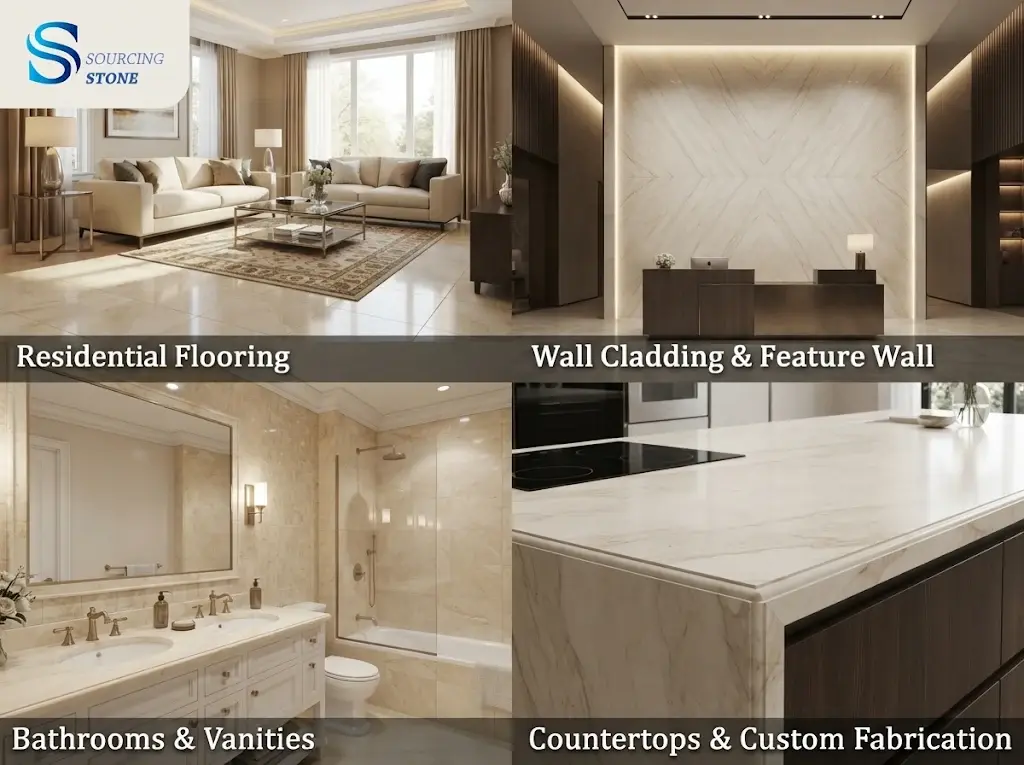
Residential and Commercial Flooring
Crema Marfil can be used for living rooms, entrance halls, corridors, hotel reception areas, and selected commercial floors. Large-format tiles or slabs can create a more continuous appearance, while smaller modules may be useful for traditional layouts and more complex floor patterns.
For a hotel project, the design team may use a consistent beige palette across the reception area and corridors. The procurement team should then coordinate slab selection, tile dimensions, finish, and installation layout. Dry-laying representative pieces before installation can reveal color differences that may not be obvious when individual samples are inspected separately.
Wall Cladding and Decorative Feature Walls
Interior wall cladding is another common application. The soft background color can create a calm visual effect in hotel rooms, residential living areas, reception spaces, and retail interiors.
For large wall surfaces, buyers should consider panel dimensions, thickness, fixing systems, substrate conditions, and the weight of the stone. Mechanical fixing or other installation systems may be necessary depending on panel size, building height, and local construction requirements.
Bathrooms, Vanities, and Wet Areas
Crema Marfil can be fabricated into vanity tops, bathroom wall panels, shower surrounds, and decorative details. Its warm tone works well with white sanitaryware, brushed metal fittings, timber cabinets, and neutral tiles.
Wet-area use requires additional planning. Buyers and installers should consider water exposure, drainage, waterproofing, sealant compatibility, slip resistance, and cleaning practices. The stone itself should not be treated as a substitute for a complete waterproofing system.
Countertops, Staircases, and Custom Fabrication
Custom stone processing can turn slabs into vanity tops, window sills, stair treads, risers, countertops, thresholds, and decorative components. Fabrication quality is particularly important around cut-outs, edges, joints, and unsupported sections.
For kitchen countertops, buyers should consider the risk of acid etching from citrus juice, vinegar, wine, and other acidic substances. Crema Marfil can be visually attractive in a kitchen, but it requires users to understand the maintenance characteristics of carbonate stone.
Material Fit by Product Direction
The following matrix is a practical material-fit guide for common stone product directions. It is an application suitability indication, not statistical data, laboratory test results, or a percentage-based performance prediction. Final suitability depends on the selected stone, finish, fabrication, installation method, and project conditions.
Legend:
- ●●● = Primary
- ●●○ = Strong Option
- ●○○ = Depends on Workflow
- — = Usually Not First Choice
| Product Direction | Material Fit | Typical Project Use | Key Selection Consideration |
|---|---|---|---|
| Мраморные плиты | ●●● | Large wall panels, floors, custom fabrication | Batch matching and slab inspection |
| Marble Tiles | ●●● | Residential floors and interior walls | Dimensional tolerance and finish consistency |
| Cut-to-Size Stone | ●●● | Staircases, thresholds, vanity components | Approved drawings and fabrication details |
| Столешницы и туалетные столики | ●●○ | Bathrooms and selected interior countertops | Staining, etching, support, and maintenance |
| Exterior Paving | ●○○ | Selected outdoor architectural projects | Weathering, slip, frost, and finish testing |
| High-Traffic Wet Flooring | ●○○ | Public and commercial circulation areas | Verified wet slip resistance and maintenance plan |
For projects requiring several types of natural stone products, buyers can compare available formats through the natural marble collection and product range. The appropriate selection should be based on the required application rather than choosing a material only because its color matches the design concept.
Crema Marfil Marble Technical Properties and Performance
Technical properties help architects, engineers, importers, and contractors determine whether a stone is suitable for a specific application. Important parameters include apparent density, water absorption, compressive strength, flexural strength, abrasion resistance, and slip resistance.
One important point is that natural stone does not have a single universal performance value. Different quarry sections, test specimens, moisture conditions, and testing procedures can produce different results. Therefore, technical values should be interpreted as material-specific evidence rather than fixed characteristics of every product sold under the same commercial name.
Published Technical Data for the Listed Product
The following table presents the technical figures published on the Sourcing Stone Crema Marfil product page. These figures should be treated as the product-page reference values, not as a guarantee for every future shipment or every Crema Marfil quarry source.
| Technical Parameter | Published Value | Test / Reference | Practical Relevance |
|---|---|---|---|
| Bulk Specific Gravity | 2.660 | Product-page specification | Indicates material density characteristics |
| Water Absorption at Atmospheric Pressure | 0.27% by weight | EN 13755 | Relevant to moisture exposure and protection |
| Modulus of Rupture, Dry | 10.3 MPa | Published product data | Resistance to bending-related failure |
| Modulus of Rupture, Wet | 10.2 MPa | Published product data | Useful for comparing dry and wet conditions |
| Compressive Strength, Dry | 208 MPa | Published product data | Resistance to compressive loading |
| Compressive Strength, Wet | 184 MPa | Published product data | Shows the reported wet-condition result |
| Flexural Strength, Dry | 8 MPa | Published product data | Relevant to bending and panel design |
| Flexural Strength, Wet | 7.9 MPa | Published product data | Relevant to moisture-conditioned performance |
Data interpretation note: The product page displays a bulk specific gravity of 2.660 with a density-style unit. Specific gravity is dimensionless; a value of 2.660 would correspond approximately to 2,660 kg/m³ when expressed as density under the relevant measurement conditions. Buyers should confirm the original laboratory report and units before using this value in engineering calculations.
The reported dry and wet compressive strength values are 208 MPa and 184 MPa respectively. This difference demonstrates why project specifications should identify the moisture condition used for testing. It is not appropriate to compare values from different suppliers without checking the test method and specimen conditions.
How Density and Water Absorption Affect Stone Selection
Density is useful when estimating material weight, planning transportation, and calculating structural loads. For example, a stone panel’s approximate mass depends on its volume and density. Thickness, panel size, fixing arrangement, and support conditions must all be considered during design.
Water absorption provides information about how much water a stone specimen absorbs under a defined test procedure. It can help inform decisions about sealing, wet-area installation, and exposure conditions. However, a low absorption result does not mean that the stone is completely stain-proof or waterproof.
Compressive Strength, Flexural Strength, and Abrasion
Compressive strength measures resistance to crushing under a specified test condition. Flexural strength evaluates resistance to bending. These properties are relevant to stone selection, but they do not replace structural design, thickness calculations, fixing-system assessment, or installation quality control.
Abrasion resistance is especially important for flooring exposed to repeated foot traffic. Buyers should request the relevant test result when the stone will be installed in airports, hotels, shopping areas, or other high-use environments. A polished sample that looks attractive in a showroom may require a different maintenance plan when used in a busy public building.
Crema Marfil Marble vs. Other Beige Natural Stones
Crema Marfil is not the only option for projects that require warm neutral stone. Botticino marble, Crema Valencia, beige travertine, and other cream-colored materials may also be considered. The best choice depends on appearance, geological structure, fabrication requirements, maintenance expectations, and budget.
Crema Marfil vs. Botticino Marble
Both stones are associated with warm beige and cream color palettes. Crema Marfil is often selected for its soft cream background and subtle natural markings. Botticino can present a different balance of beige tones, cloudy patterns, and mineral features depending on the specific commercial variety.
For a project requiring a consistent appearance, buyers should compare actual slabs from the proposed production batch rather than relying on generic product photographs.
Crema Marfil vs. Crema Valencia
Crema Valencia is another commercial name used for cream-toned natural stone. Similar names do not guarantee identical geological characteristics or performance. Procurement teams should confirm the stone’s origin, petrographic description, technical values, and sample appearance.
Crema Marfil vs. Beige Travertine
Travertine has a different geological structure and often contains natural pores or cavities that may be left open or filled during processing. Marble generally presents a more crystalline and compact visual structure, although actual characteristics vary by material.
Travertine may be preferred for rustic or textured design concepts, while Crema Marfil can be selected when a smoother, more continuous cream-colored appearance is desired. The correct decision should consider both design intent and maintenance requirements.
| Material | Typical Appearance | Structure | Selection Consideration |
|---|---|---|---|
| Крема Марфил | Warm cream and beige | Carbonate natural stone | Batch consistency and surface finish |
| Botticino | Beige with varied natural markings | Carbonate natural stone | Specific variety and color selection |
| Crema Valencia | Cream and beige tones | Verify by source | Confirm origin and petrographic identity |
| Beige Travertine | Beige with characteristic pores and bands | Porous carbonate stone | Filling, texture, and maintenance |
How Much Does Crema Marfil Marble Cost?
Crema Marfil Marble Price depends on more than the name of the stone. Buyers should evaluate the complete delivered specification, including grade, block selection, dimensions, thickness, finish, fabrication, packaging, and transportation.
Factors That Influence Wholesale Pricing
- Material selection: More consistent color and pattern requirements may reduce the number of acceptable slabs and increase selection costs.
- Толщина: Different thicknesses affect material consumption, processing, weight, and shipping calculations.
- Размеры: Large slabs, standard tiles, and customized components require different production workflows.
- Surface finish: Polishing, honing, brushing, and textured treatments involve different processing steps.
- Fabrication: Cut-outs, edge profiles, stair components, and customized shapes add labor and production complexity.
- Order quantity: Larger orders may improve production planning, but availability and batch consistency still need confirmation.
- Packaging and logistics: Crates, protective materials, loading, freight, insurance, and destination charges affect the landed cost.
Slabs, Tiles, and Cut-to-Size Products
Slabs are commonly selected for large wall panels, countertops, and custom fabrication. Tiles are useful for modular flooring and wall installations, while cut-to-size products are suitable for stairs, thresholds, vanity components, and project-specific details.
Buyers should compare quotations on an equivalent basis. A quotation for polished slabs is not directly comparable with a quotation for finished tiles if the latter includes cutting, calibration, surface treatment, packing, or additional processing.
Estimating Material Requirements and Cutting Allowance
Suppose a project requires 100 square meters of finished stone flooring. If the procurement team uses a provisional 10% allowance for cutting and installation waste, the initial planning quantity would be:
100 m² × 1.10 = 110 m²
This is an illustrative estimating method, not a universal waste allowance. Actual requirements depend on room geometry, tile dimensions, slab yield, vein direction, layout pattern, edge conditions, and the number of cuts. A detailed cutting plan should be prepared before confirming the final order quantity.
How to Choose a Reliable Crema Marfil Marble Supplier or Manufacturer
For international buyers, supplier selection is a major part of project risk management. A competitive quotation is useful, but it does not prove that the supplier can deliver the required appearance, dimensions, finish, and documentation consistently.
Verify Material Origin and Batch Consistency
Buyers should ask where the stone is sourced and whether the proposed material comes from the same block, quarry section, or production batch. When a project requires visual consistency across several rooms or floors, batch planning becomes especially important.
Request clear photographs of the actual slabs rather than relying only on catalog images. Photographs should be taken under reasonably consistent lighting and should show the entire slab where possible. Video inspection can provide additional context, but it should not replace agreed acceptance criteria.
Evaluate Factory Processing and Customization Capabilities
A capable stone manufacturer should be able to explain its cutting, polishing, calibration, inspection, and packing procedures. Buyers should also confirm whether the supplier can produce the required slab sizes, tile dimensions, thicknesses, edge profiles, and customized components.
For example, a hotel renovation may require standard floor tiles, stair treads, vanity tops, and decorative wall panels. If these items are produced under different specifications without coordinated quality control, differences in color, thickness, or finish may become visible during installation.
When comparing a Crema Marfil Marble Supplier или Crema Marfil Marble Manufacturer, buyers should evaluate actual processing resources, inspection procedures, communication, and shipment coordination rather than relying on marketing descriptions alone.
Request Samples, Technical Documents, and Inspection Records
Before placing a wholesale order, ask for a representative sample and the relevant technical documents. For larger projects, request a documented approval process covering color range, acceptable natural markings, thickness tolerance, surface finish, and packaging requirements.
Sourcing Stone describes its operations as including stone processing, inspection, and sourcing support. Its company information lists a 23,000-square-meter factory area, more than 200 skilled workers, over 70 machines, and a stated monthly production capacity of 100,000 square meters. These are supplier-published company figures and should be evaluated alongside project-specific production schedules, inspection records, and order confirmations.
Questions to Ask Before Placing a Wholesale Order
- Can the supplier confirm the material source and proposed production batch?
- Are the required slab, tile, and cut-to-size dimensions available?
- Can the supplier provide photographs or videos of the actual selected material?
- Are thickness, flatness, and surface-finish tolerances documented?
- Can the supplier provide relevant laboratory test reports?
- How are slabs and tiles protected during international transportation?
- What inspection and replacement procedures apply if goods arrive damaged or outside the agreed specification?
A professional purchasing process should also confirm lead time, production milestones, loading arrangements, shipping documents, and the process for handling discrepancies. For buyers sourcing several natural stone types, consolidated sourcing and shipment planning can simplify project coordination.
To review the specific material description, available product forms, and published specifications, buyers can examine the Crema Marfil Marble product details and specifications before preparing a project inquiry or requesting a quotation.
International Standards, Quality Control, and Installation Considerations
Natural stone procurement for international construction projects should be based on the intended use and applicable technical requirements. Standards help define how properties are tested, but a test method does not automatically establish that a stone is suitable for every installation.
Relevant Natural Stone Testing Standards
| Стандарт | Testing Focus | Why It Matters |
|---|---|---|
| EN 1936 | Density and porosity | Helps characterize the stone structure |
| EN 13755 | Water absorption at atmospheric pressure | Supports moisture-related evaluation |
| EN 1926 | Прочность на сжатие | Measures resistance to compressive loading |
| EN 12372 | Flexural strength under concentrated load | Relevant to bending performance |
| EN 14157 | Abrasion resistance | Useful for flooring applications |
| ASTM C97/C97M | Absorption and bulk specific gravity | Provides a recognized testing procedure |
| ASTM C170/C170M | Прочность на сжатие | Supports material comparison and specification |
| ASTM C880/C880M | Flexural strength | Evaluates bending resistance |
CE Marking and European Construction Product Requirements
For products supplied to European construction markets, buyers should identify the relevant harmonized product standard and regulatory requirements for the product’s intended use. Natural stone products used for flooring, stairs, and cladding may fall under different product specifications.
EN 12058 addresses natural stone products used for flooring and stairs, while EN 12057 covers modular tiles. The applicable documentation and conformity requirements depend on the specific product category, intended use, and current regulatory framework.
Regulation (EU) 2024/3110 establishes a revised framework for construction products and repeals Regulation (EU) No 305/2011, subject to its transitional and application provisions. Buyers should verify the latest applicable harmonized specifications and implementation dates rather than assuming that every stone product follows the same documentation route.
Installation and Quality Inspection
Even a well-selected stone can perform poorly if installation is not properly planned. Before installation, contractors should inspect the substrate, verify dimensions, check the adhesive or fixing system, and confirm that the selected stone finish is appropriate for the environment.
Dry-laying representative tiles or panels can help identify visual differences before permanent installation. For large projects, an installation mock-up is useful for checking joints, color distribution, lighting effects, edge details, and the relationship between different materials.
Cleaning, Sealing, and Maintaining Crema Marfil Marble
As a carbonate-based natural stone, Crema Marfil requires suitable cleaning and maintenance practices. Acidic substances can react with calcium carbonate and create dull marks or etching. The risk is relevant in kitchens, bathrooms, restaurants, and other environments where acidic liquids may contact the surface.
Daily Cleaning and Suitable Products
For routine cleaning, use a soft cloth or microfiber mop with clean water and a pH-neutral cleaner specifically recommended for natural stone. Avoid abrasive pads, harsh scouring powders, and cleaners containing acids unless a qualified stone-care professional has confirmed their suitability for a specific treatment.
Wine, coffee, cooking oil, cosmetics, and other staining substances should be removed promptly. Blot spills rather than aggressively rubbing them across the surface. If a stain remains, use a stain-removal product or poultice designed for the particular stain and stone type.
Sealing and Stain Prevention
Some Crema Marfil installations may benefit from an appropriate impregnating treatment. However, sealing does not make marble completely stain-proof, and it does not prevent acid etching. The correct product and application schedule depend on the stone’s absorption characteristics, finish, exposure, and manufacturer’s instructions.
Before applying a sealer across a large surface, test it on an inconspicuous area. Confirm that it does not create unwanted darkening, uneven appearance, or residue. Food-preparation surfaces require products specifically suitable for the intended use.
Common Maintenance Mistakes to Avoid
- Using vinegar, lemon-based cleaners, or acidic bathroom products on carbonate stone.
- Assuming that a polished surface is automatically stain-proof.
- Leaving coffee, wine, oil, or cosmetics on the surface for extended periods.
- Using abrasive tools that can scratch or dull the finish.
- Applying an unsuitable sealer without checking compatibility.
- Ignoring moisture problems that may cause efflorescence or installation-related deterioration.
For a more detailed maintenance procedure, buyers and property managers can consult the Crema Marfil Marble cleaning and care guide. Maintenance instructions should always be adapted to the actual finish, treatment, and condition of the installed stone.
Crema Marfil Marble Industry Trends and Future Design Applications
Continued Interest in Warm Neutral Natural Stone
Warm neutral palettes remain relevant in residential and hospitality design because they can work with a wide range of furniture, lighting, wood finishes, and architectural materials. Cream and beige marble can create a softer visual atmosphere than high-contrast stone patterns.
Designers increasingly combine natural stone with timber, brushed metal, glass, and neutral wall finishes. In these applications, Crema Marfil can act as a background material that connects different design elements without becoming visually overwhelming.
Large-Format Slabs and Customized Fabrication
Large-format stone panels can reduce the number of visible joints and create a more continuous appearance. At the same time, larger panels require careful handling, transport protection, dimensional control, and appropriate installation systems.
Customized fabrication is also important for projects that require matching floor tiles, wall panels, stair components, and vanity products. Coordinating these items during procurement can reduce material mismatch and simplify installation planning.
Responsible Sourcing and Processing
Environmental considerations are becoming more important in construction-material procurement. Buyers may request information about quarry management, water recycling, dust control, waste handling, packaging, and transportation planning.
For natural stone, responsible sourcing should be evaluated through traceable supply information and credible operational documentation. Broad environmental claims should not replace verifiable evidence. Project teams should also consider service life, repairability, maintenance requirements, and the efficient use of each block during fabrication.

Frequently Asked Questions About Crema Marfil Marble
1. What Is Crema Marfil Marble Known For?
Crema Marfil Marble is known for its warm cream-to-beige background, subtle natural veining, and versatile appearance. It is commonly selected for residential flooring, hotel interiors, wall cladding, bathroom vanities, and decorative architectural details. Its neutral color works with wood, white surfaces, metal, and other natural stones. However, color and pattern can vary between blocks and production batches, so buyers should inspect representative slabs before confirming large orders.
2. Where Does Crema Marfil Marble Come From?
Crema Marfil is traditionally associated with the Alicante province in southeastern Spain, particularly areas around Pinoso and Novelda. It is widely recognized in international natural stone markets as a Spanish cream-colored marble. Because commercial stone names and sourcing arrangements can vary, buyers should confirm the actual origin and geological description of the material offered by a supplier rather than relying only on the product name.
3. Is Crema Marfil Marble Suitable for Flooring?
Yes, Crema Marfil can be used for residential and commercial flooring when the selected material, thickness, finish, and installation system are appropriate for the intended environment. Polished finishes provide a reflective appearance, while honed or textured finishes offer a softer surface character. For public or wet areas, buyers should request relevant slip-resistance test results and consider expected foot traffic, cleaning frequency, and maintenance requirements before specifying the stone.
4. Is Crema Marfil Marble Good for Bathrooms and Kitchens?
Crema Marfil can be used for bathroom walls, vanity tops, selected countertops, and other interior applications. Its warm neutral color is easy to coordinate with many bathroom and kitchen designs. However, carbonate stone is sensitive to acidic substances, which can cause etching. Proper installation, suitable waterproofing, prompt spill removal, compatible cleaning products, and an appropriate maintenance plan are important. Buyers should evaluate the specific finish and application before using it in heavily exposed areas.
5. How Much Does Crema Marfil Marble Cost?
The cost of Crema Marfil Marble depends on grade, color consistency, slab size, thickness, surface finish, fabrication requirements, order quantity, packaging, and transportation. Customized cut-to-size products may involve additional processing compared with standard slabs or tiles. For an accurate wholesale quotation, buyers should provide the required dimensions, finish, estimated quantity, project location, and quality expectations. Comparing quotations on the same technical and commercial basis helps avoid unexpected costs.
References
- Crema Marfil Marble – Product Details and Technical Specifications
Author: Technical and Product Information Team
Organization: Sourcing Stone
Source: Sourcing Stone official product documentation. - About Sourcing Stone – Factory, Equipment, and Quality Control
Author: Sourcing Stone Company Team
Organization: Quanzhou Sourcing Stone Co., Ltd.
Source: Official company profile and manufacturing information. - Care & Cleaning of Natural Stone
Author: Technical and Consumer Education Contributors
Organization: Natural Stone Institute
Source: Natural Stone Institute consumer care and maintenance guidance. - Crema Marfil – Technical Sheet
Author: Technical Department
Organization: Fiorantina Stone
Source: Published Crema Marfil technical product sheet. - Crema Marfil – Physical and Mechanical Properties
Author: Technical Documentation Team
Organization: Mármoles Roni Mar
Source: Published natural stone technical data sheet. - ASTM C97/C97M – Standard Test Methods for Absorption and Bulk Specific Gravity of Dimension Stone
Author: ASTM Committee C18 on Dimension Stone
Organization: ASTM International
Source: ASTM dimension stone testing standard. - ASTM C170/C170M – Standard Test Method for Compressive Strength of Dimension Stone
Author: ASTM Committee C18 on Dimension Stone
Organization: ASTM International
Source: ASTM dimension stone testing standard. - Regulation (EU) 2024/3110 – Construction Products Regulation
Author: European Parliament and Council of the European Union
Organization: European Union
Source: Official Journal of the European Union, 2024.
Crema Marfil Marble: Key Selection Insights for Designers, Buyers, and Project Contractors
How Should Buyers Select Crema Marfil Marble?
Start with the intended application, required appearance, and project environment. Define the acceptable color range, grade description, slab or tile dimensions, thickness, finish, and technical requirements before requesting quotations. Review actual production-batch photographs and representative samples, then confirm inspection and acceptance criteria in writing.
Why Does Material Verification Matter?
Natural stone varies between blocks and production batches. A visually attractive sample cannot guarantee that every slab in a large order will have identical color or veining. Technical reports, batch inspection, dimensional checks, and approved samples reduce uncertainty and help align the supplier’s production with the project’s expectations.
What Makes Crema Marfil Suitable for Different Interior Projects?
Its warm neutral appearance allows it to coordinate with a wide range of interior materials. Depending on the selected finish and technical characteristics, it can be fabricated into flooring, wall cladding, vanity tops, stair components, and decorative elements. Application suitability must still be verified against moisture exposure, abrasion, slip resistance, fixing requirements, and maintenance expectations.
Which Product Options Should a Project Buyer Consider?
Slabs are useful for large surfaces and customized fabrication. Tiles can simplify modular flooring and wall layouts. Cut-to-size products support project-specific dimensions, staircases, thresholds, and vanity components. The most efficient option depends on the design drawings, cutting plan, material yield, installation method, and shipping requirements.
What Should Buyers Consider Before Confirming a Wholesale Order?
Confirm the material source, batch consistency, grade definition, finish, dimensions, tolerances, inspection procedure, packaging, lead time, and shipping terms. Request relevant test documentation when performance is important to the project. For large installations, coordinate dry-lay approval and pre-shipment inspection before final packing. A detailed written specification is more reliable than a general product description or verbal quality promise.
How Are Market Expectations Influencing Natural Stone Procurement?
Buyers increasingly evaluate natural stone through a combination of visual design, technical performance, processing capability, supply-chain transparency, and responsible sourcing. Large-format panels and customized fabrication create opportunities for distinctive interiors, but they also require better dimensional control and handling. Suppliers that communicate clearly and provide traceable quality information can help reduce procurement and installation risks.
Final Insight: Crema Marfil Marble is best selected through a complete project-based evaluation rather than color preference alone. When buyers combine visual inspection, verified technical data, suitable finishes, professional fabrication, and clear purchasing specifications, they can make more reliable decisions for residential, hospitality, and commercial stone projects.
For project planning, wholesale sourcing, or customized stone requirements, request current material photographs, available dimensions, finish options, and project-specific technical documentation before confirming an order.