Grey Marble is a versatile natural stone for contemporary residential and commercial interiors, combining distinctive mineral veining, neutral color tones, and multiple surface finishes. From Grey Marble flooring and wall cladding to countertops and hotel feature walls, it offers designers a flexible material option when appearance, technical performance, installation conditions, and long-term maintenance are evaluated together.
Grey Marble: A Natural Design Statement for Modern and Timeless Interiors
Interior design increasingly relies on materials that can create a distinctive visual identity without limiting future design choices. Natural stone remains an important option because its mineral structure, color variation, and surface patterns bring depth that manufactured decorative materials may not fully reproduce. Among the available natural stones, Grey Marble has become a popular choice for designers, architects, property developers, and homeowners seeking a balance between understated elegance and architectural character.
Its appeal comes from more than its color. Grey marble can feature delicate white veins, dramatic silver patterns, cloudy mineral textures, or relatively uniform backgrounds. These variations allow it to work in minimalist apartments, luxury villas, hospitality interiors, retail environments, and commercial reception areas. Depending on the selected variety and finish, the stone can create either a quiet background or a prominent focal point.
However, choosing marble requires more than comparing photographs. Buyers need to consider natural variation, water absorption, surface hardness, finish, installation conditions, maintenance requirements, and the quality of fabrication. This guide examines eight reasons why grey marble is widely considered for interior design and explains how to evaluate it for practical projects.
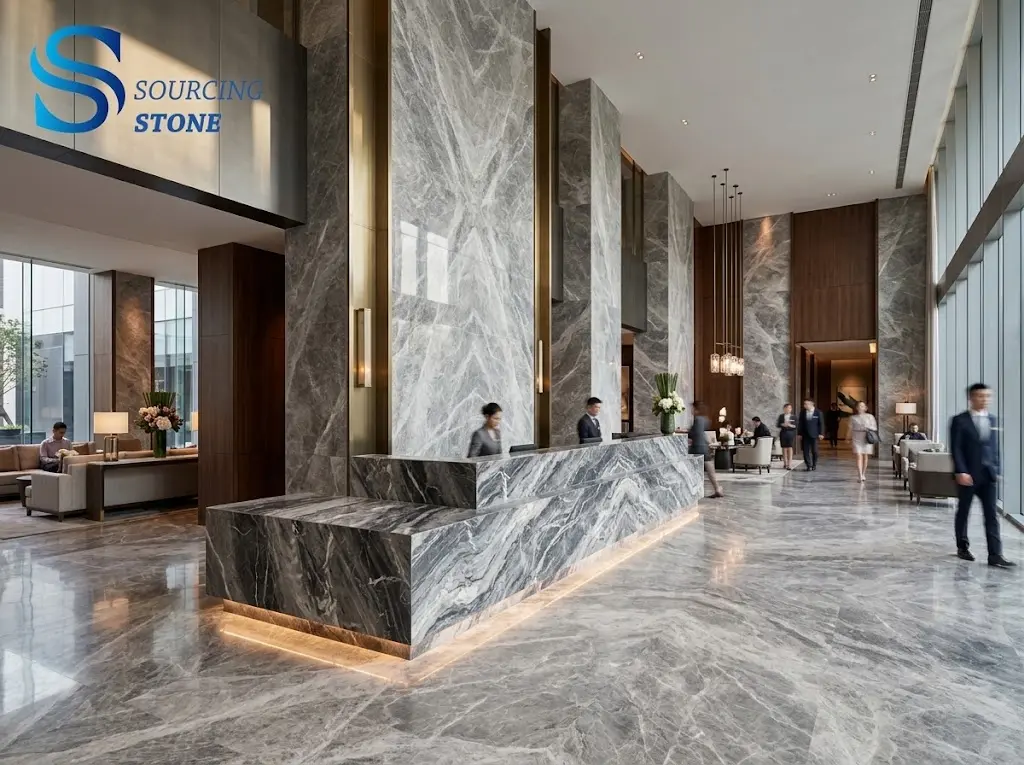
What Is Grey Marble and What Makes It Different?
How Natural Grey Marble Is Formed
Marble is a metamorphic rock that generally forms when limestone or dolostone is exposed to heat, pressure, and chemically active fluids over geological periods. During metamorphism, the original carbonate minerals recrystallize, creating the interlocking crystalline structure associated with marble. The presence of different minerals and impurities can influence the stone’s background color, veining, and overall appearance.
Grey tones may result from mineral impurities and variations in the geological environment. Depending on the quarry and geological history, a slab may display fine white veins, darker mineral bands, cloudy patterns, or a combination of several visual features. This natural formation process explains why two slabs from the same quarry may not look identical.
Common Grey Marble Colors and Patterns
Light grey marble often creates a softer and brighter impression, making it suitable for smaller rooms, bathrooms, and interiors with limited natural light. Medium grey varieties provide a balanced appearance that can coordinate with wood, white cabinetry, and metal details. Dark grey marble creates stronger contrast and is often selected for feature walls, fireplace surrounds, reception counters, and other focal applications.
Veining is another important selection factor. Linear veins can emphasize direction and visual movement, while cloudy patterns create a softer, more organic effect. Strongly contrasting veins may become the central design feature of a room. Before confirming an order, project teams should inspect full slabs rather than relying exclusively on small samples.
Popular Grey Marble Surface Finishes
| Finish | Appearance | Typical Applications | Selection Consideration |
|---|---|---|---|
| Polished | Glossy and reflective | Feature walls, decorative counters, selected floors | Can become slippery when wet; shows reflections clearly |
| Honed | Smooth, matte appearance | Bathrooms, floors, contemporary interiors | Still requires appropriate slip-resistance assessment |
| Leathered | Subtle texture with low sheen | Selected counters and decorative surfaces | Texture and cleaning behavior vary by stone |
| Brushed | Softly textured surface | Decorative flooring and selected wall applications | Confirm finish consistency and maintenance needs |
Top 8 Reasons Why Grey Marble Is the Choice for Interior Design
1. A Timeless Neutral Color That Works Across Interior Styles
One of the strongest advantages of grey marble is its ability to complement a wide range of interior palettes. Grey is a neutral color that can work with warm or cool materials, allowing designers to coordinate stone surfaces with furniture, wall finishes, lighting, and architectural details. Unlike highly saturated colors, a carefully selected grey tone can remain visually relevant as decorative accessories and furniture are updated.
In minimalist interiors, light grey marble can create a calm visual foundation. In industrial-style spaces, medium and dark grey varieties can coordinate with exposed concrete, black metal, and glass. In more traditional interiors, grey marble can be paired with timber, brass, warm lighting, and detailed cabinetry to create a balanced combination of natural materials.
This flexibility is particularly useful in multi-room projects. A designer may use one grey marble family across a bathroom vanity, a hallway floor, and a feature wall while adjusting the finish and slab pattern for each application. For projects comparing darker stone palettes, the design implications of grey marble versus black marble are worth evaluating in relation to lighting, room size, furniture colors, and the desired visual contrast.
2. Unique Natural Veining Creates an Individual Visual Identity
Natural veining gives each marble slab a visual character that cannot be completely standardized. Some grey marble varieties contain delicate white lines that create a subtle decorative effect. Others feature strong silver or charcoal veins that become a prominent part of the interior composition. This natural variation makes the stone suitable for projects where material character is an important part of the design concept.
Large feature walls can benefit from carefully planned vein alignment. Bookmatching is one approach in which adjacent slabs are arranged so their patterns mirror each other. When the material is selected and fabricated correctly, this technique can create a symmetrical visual composition for hotel reception walls, living-room features, and luxury bathroom interiors.
Vein direction should also be considered when planning flooring and wall cladding. Horizontal patterns may visually extend a wall, while vertical patterns can emphasize height. These effects depend on the actual slab pattern, room dimensions, lighting, and installation layout. Buyers should request slab photographs with dimensions or inspect the actual material before approving a large order.
3. Excellent Compatibility with Different Materials and Colors
Grey marble can coordinate with a broad range of materials. Its neutral background allows designers to introduce contrast through timber, metal, glass, textiles, and painted surfaces. This makes it useful in projects where several finishes must work together without creating a visually crowded environment.
Light grey marble can be combined with white oak, pale cabinetry, and warm beige walls for a soft residential interior. Dark grey marble can create a stronger contrast with brushed brass, black steel, or walnut furniture. Stainless steel and glass can reinforce a contemporary appearance in kitchens, offices, and commercial reception spaces.
Lighting is equally important. Natural daylight may reveal subtle mineral patterns that are less visible under warm artificial lighting. Directional lighting can emphasize surface texture, while broad ambient lighting can make a polished slab appear brighter. A practical design review should therefore evaluate the selected slab under lighting conditions similar to those expected in the completed project.
4. Suitable for Multiple Interior Applications
A major reason designers consider grey marble is its adaptability across different interior surfaces. Depending on the stone’s tested properties, thickness, finish, and installation system, it may be used for flooring, wall cladding, vanity tops, decorative counters, fireplace surrounds, and reception desks.
| Application | Design Benefits | Important Considerations |
|---|---|---|
| Living room flooring | Creates a continuous natural-stone appearance | Traffic, surface finish, scratching, and maintenance |
| Bathroom walls | Supports a refined, spa-inspired design | Waterproofing, sealing, and installation details |
| Bathroom flooring | Provides a coordinated natural surface | Wet slip resistance and drainage design |
| Kitchen countertops | Creates a distinctive natural focal point | Acid etching, staining, scratching, and care |
| Hotel lobbies | Creates a premium architectural impression | High foot traffic, cleaning frequency, and replacement planning |
| Reception desks | Provides a strong visual focal point | Edge fabrication, support, and handling |
| Fireplace surrounds | Adds natural texture and visual depth | Heat exposure and system-specific installation requirements |
In residential projects, grey marble may connect a living area with a hallway or create a coordinated bathroom scheme. In hospitality projects, it can be used to establish a consistent visual language across reception areas, corridors, and selected guest spaces. The suitability of each application must be confirmed for the actual stone variety and operating environment.
5. Different Finishes Offer More Design Possibilities
The finish applied to a marble slab changes how its color, veins, and surface texture are perceived. A polished finish reflects more light and can make veins appear visually pronounced. A honed finish reduces surface reflection and is often selected for contemporary interiors that favor a softer appearance. Textured finishes introduce tactile variation and may be considered for specific decorative or flooring applications.
Finish selection should not be based on appearance alone. A polished surface may be unsuitable for certain wet-floor environments if the measured slip performance does not meet project requirements. A honed surface is not automatically slip-proof, and a textured surface is not automatically easy to clean. Designers should review the actual finish sample and request relevant performance information for the intended use.
A useful approach is to select the stone variety first, review the available finish samples, and then evaluate how the finish performs under the expected lighting, cleaning, and traffic conditions. This helps prevent a common purchasing mistake: approving a finish based on a showroom sample without considering the final installation environment.
6. Natural Stone Offers Individuality and Long-Term Design Value
Natural marble has a visual quality that comes from its geological formation. Mineral patterns, tonal transitions, and crystalline details create differences from slab to slab. For architects and designers, this individuality can be an advantage when a project requires a material with a distinctive natural appearance rather than a perfectly repeated decorative pattern.
Grey is also a relatively adaptable design color. It can remain compatible with changing furniture styles, wall colors, and decorative accessories. This does not mean that every marble installation will increase property value or remain maintenance-free. Long-term value depends on material selection, installation workmanship, maintenance practices, local market expectations, and the condition of the stone over time.
Marble is generally more sensitive to scratching and acidic substances than many harder countertop materials. Buyers should understand this characteristic before choosing it for heavily used kitchen work surfaces. Where natural appearance is the priority and the owner accepts appropriate care requirements, marble can be a suitable design choice.
7. Large Slabs and Custom Fabrication Support Seamless Designs
Large-format slabs allow designers to create expansive surfaces with fewer visible joints than smaller modular pieces. This can be particularly effective for feature walls, bathroom surrounds, reception counters, and selected floor layouts. The visual result depends on slab dimensions, vein direction, cutting plans, and the installer’s ability to maintain consistent joint alignment.
Custom fabrication can include straight or shaped cuts, edge profiles, vanity openings, mitered corners, and bookmatched arrangements. These details should be planned before production begins. A cutting diagram can help the fabricator estimate material yield, identify visible joints, and reduce unnecessary waste.
Buyers sourcing grey marble slabs for modern homes should evaluate the actual slab dimensions, thickness, surface quality, and pattern continuity. For wholesale orders, it is also important to confirm whether the supplier can maintain a consistent selection across multiple bundles or production batches. A sample approval process and clear inspection criteria can reduce disputes when the material reaches the project site.
8. A Versatile Material for Residential and Commercial Projects
Residential and commercial projects have different performance requirements, but grey marble can be considered in both when the selected variety is suitable for the intended environment. In apartments and villas, the material may be used for living-room floors, bathroom walls, vanity tops, and decorative fireplaces. In hotels and offices, it may be selected for reception desks, feature walls, corridors, and other high-visibility areas.
Commercial buyers should pay particular attention to foot traffic, cleaning frequency, replacement availability, and maintenance planning. A visually attractive stone that requires frequent specialist care may not be the best choice for every public space. Project teams should compare the expected appearance with the practical cost of maintaining the surface throughout its service life.
Minimalist interiors often use stone as one part of a larger material composition rather than covering every surface. A grey marble feature wall, a coordinated floor, or a single statement counter can provide enough natural texture without overwhelming the room. For inspiration, grey marble minimalist interior design ideas can be evaluated through room proportions, furniture scale, lighting, and the balance between stone and softer materials.
Grey Marble Material Properties: What Should Buyers and Designers Know?
Typical Physical and Technical Characteristics
Technical properties help determine whether a particular marble variety is suitable for flooring, cladding, countertops, or other applications. However, natural stone is not a uniform manufactured product. Density, absorption, strength, and surface behavior can vary according to mineral composition, geological formation, quarry location, and the presence of natural discontinuities.
The following table provides broad reference ranges commonly used for preliminary material discussions. These figures are not product specifications and must not be used as a substitute for laboratory test reports for the actual stone being purchased.
| Property | General Reference Range | Project Relevance |
|---|---|---|
| Bulk density | Approximately 2,600–2,800 kg/m³ | Material weight, handling, and structural calculations |
| Water absorption | Often below 1%, but varies by variety | Moisture exposure and staining risk assessment |
| Compressive strength | Broadly around 50–150 MPa | Mechanical assessment for the intended application |
| Flexural strength | Varies significantly by stone and test direction | Slab handling, cladding design, and installation |
| Mohs hardness | Approximately 3–4 for typical calcite-rich marble | Relative scratch resistance; not a complete durability rating |
| Surface finish | Polished, honed, brushed, leathered, and other finishes | Appearance, cleaning, and slip-performance evaluation |
The reference values above are indicative ranges for preliminary comparison, not guaranteed values for every grey marble. Buyers should request test reports for the exact material batch or quarry variety. In particular, water absorption and flexural strength are important when evaluating stone for wet areas, flooring, and mechanically fixed cladding.
Why Natural Stone Testing Matters Before Purchase
Relevant testing methods may include ASTM C97/C97M for absorption and bulk specific gravity, ASTM C99/C99M for modulus of rupture, ASTM C170/C170M for compressive strength, and ASTM C880/C880M for flexural strength. In European projects, EN 1469 addresses natural stone products used as cladding slabs, while EN 12058 covers natural stone slabs for floors and stairs.
Not every test is necessary for every application. A decorative wall panel, a bathroom floor, and a countertop have different exposure and performance requirements. The project specification should identify the required tests and acceptance criteria before procurement. This reduces the risk of choosing a material based only on appearance.
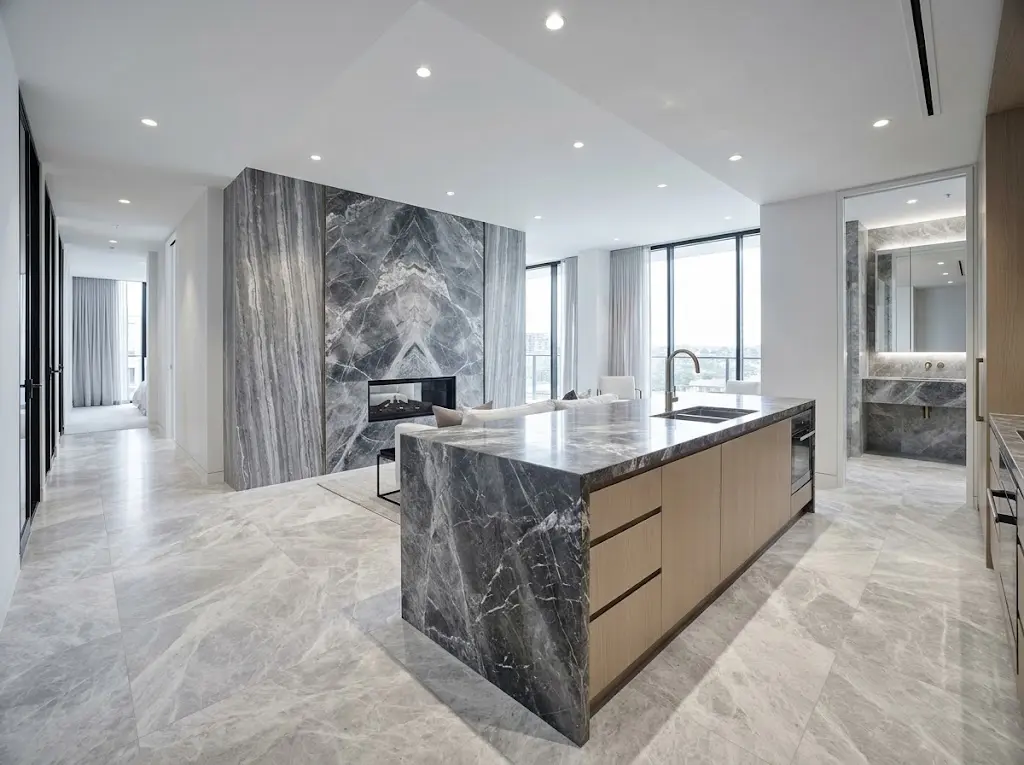
Material Fit by Product Direction: Which Grey Marble Should You Consider?
A useful product selection process begins by separating visual direction from technical suitability. Light grey slabs, dark grey slabs, strongly veined materials, and more uniform grey varieties can serve different design purposes. The following matrix is a qualitative material fit guide to support early project discussions. It is an application suitability indication, not statistical data, a performance guarantee, or a measured probability. No precise percentages are assigned because suitability depends on the actual stone, finish, fabrication, installation, and project environment.
Legend:
●●● = Primary |
●●○ = Strong Option |
●○○ = Depends on Workflow |
— = Usually Not First Choice
| Product Direction | Feature Walls | Flooring | Bathroom | Countertops | Commercial Projects |
|---|---|---|---|---|---|
| Light Grey Marble | ●●○ | ●●● | ●●○ | ●○○ | ●●○ |
| Dark Grey Marble | ●●● | ●●○ | ●●○ | ●○○ | ●●● |
| Grey Veined Marble | ●●● | ●●○ | ●●○ | ●●○ | ●●● |
| Uniform Grey Marble | ●●○ | ●●● | ●●○ | ●○○ | ●●○ |
| Honed Grey Marble | ●●○ | ●●○ | ●●○ | ●○○ | ●●○ |
These product directions are useful for organizing a stone catalog or preparing an initial project shortlist. They are not a claim that every supplier stocks every category, nor do they replace product-specific test results. Actual availability, slab dimensions, thickness, finish, and technical data should be confirmed with the supplier.
For a project-specific shortlist, buyers can organize product entries under light grey marble slabs, dark grey marble slabs, grey veined marble, and honed grey marble. Each product entry should ideally include actual slab photographs, dimensions, finish options, origin information where available, and the relevant test documentation. These catalog groupings can be connected to the website’s corresponding product pages once the actual product URLs and inventory are confirmed.
Grey Marble vs White Marble vs Granite: Which Is Better?
Visual and Functional Comparison
Grey marble, white marble, and granite are all used in interior projects, but they offer different visual and practical characteristics. Grey and white marble are carbonate-based natural stones in many common varieties, while granite is an igneous rock with a different mineral composition and generally higher hardness. These broad differences are useful for initial selection, but individual stone performance still varies.
| Factor | Grey Marble | White Marble | Granite |
|---|---|---|---|
| Appearance | Grey backgrounds with varied veining | Bright backgrounds and varied patterns | Granular mineral texture |
| Design character | Contemporary and versatile | Bright, classic, and elegant | Natural and often visually granular |
| Hardness | Generally lower than granite | Generally lower than granite | Generally higher |
| Acid sensitivity | Generally sensitive | Generally sensitive | Often less sensitive, depending on composition |
| Common uses | Floors, walls, bathrooms, feature surfaces | Floors, walls, vanities, decorative surfaces | Floors, countertops, selected commercial surfaces |
When Should You Choose Grey Marble?
Grey marble is worth considering when the project needs a neutral natural surface with distinctive veining and a contemporary appearance. White marble may be a better visual fit when brightness and a classic aesthetic are the main priorities. Granite may be more suitable where scratch resistance and demanding countertop use are particularly important.
No material should be selected by color alone. Buyers should compare test results, maintenance expectations, surface finish, installation conditions, and the intended use. A carefully selected grey marble may be appropriate for a feature wall or a residential floor even when another material would be more practical for a heavily used kitchen worktop.
How to Choose the Right Grey Marble for Your Interior Project
Select the Right Color and Veining Pattern
Begin by defining the room’s lighting, color palette, and desired visual effect. Light grey stone can support a brighter atmosphere, while darker varieties may create depth and contrast. Review the actual slabs in the context of the project’s flooring, cabinetry, wall colors, and lighting plan. For large areas, confirm whether the selected bundles provide an acceptable level of visual consistency.
Choose the Right Thickness, Size, and Finish
Common natural-stone slab thicknesses may include 18 mm and 20 mm, although availability and suitability depend on the market, stone variety, fabrication method, and installation system. Thicker material is not automatically the best solution for every application. Large-format cladding may require mechanical fixing or a designed support system, while countertop fabrication needs appropriate support around openings and overhangs.
Evaluate Supplier Capability and Quality Control
A professional grey marble supplier should be able to explain available material options, slab dimensions, finish consistency, inspection procedures, packaging, and delivery arrangements. Buyers should request photographs or videos of the actual slabs, confirm the agreed selection before production, and establish written acceptance criteria for color variation, cracks, repairs, thickness, and surface defects.
For wholesale or project procurement, it is useful to confirm production capacity, batch identification, packing methods, and the process for handling transit damage. A reliable grey marble manufacturer or processing partner should communicate clearly about what can be controlled and what remains a natural characteristic of the stone. Company background and project coordination information may also help buyers understand how different building trades and material suppliers communicate during a project.
Maintenance, Sealing, and Common Grey Marble Problems
Does Grey Marble Need Sealing?
Sealing requirements depend on the stone’s porosity, finish, location, and exposure to liquids or contaminants. Some marble surfaces may benefit from an appropriate penetrating sealer, while others may require a different maintenance approach. A sealer can reduce the rate at which certain liquids penetrate the stone, but it does not make marble stain-proof, scratch-proof, or acid-resistant.
Before applying a sealer, test the actual stone and follow the product manufacturer’s instructions. The treatment should be compatible with the marble and its finish. Reapplication frequency should be determined by product guidance, site conditions, and the results of periodic water or absorption checks rather than by an arbitrary universal schedule.
How to Prevent Scratches, Etching, and Stains
Routine care should use a cleaner formulated for natural stone, generally with a neutral pH. Acidic household products such as vinegar, lemon juice, and some bathroom cleaners can react with calcite-rich marble and create dull marks known as etching. Spills should be cleaned promptly, and abrasive pads should be avoided unless specifically approved for the surface.
In kitchens, use cutting boards and protective mats. In bathrooms, maintain appropriate ventilation and remove standing water where practical. Furniture pads can reduce scratching on floors, while entrance mats can help limit the amount of abrasive grit carried into high-traffic spaces.
Common Purchasing and Installation Mistakes
- Approving a large order using only a small sample rather than reviewing the actual slabs.
- Assuming every grey marble variety has the same water absorption or strength.
- Choosing a polished finish for a wet floor without checking slip performance.
- Failing to coordinate slab dimensions, vein direction, and cutting plans.
- Assuming that sealing prevents all staining, scratching, or acid etching.
- Ignoring transport protection, edge damage, and inspection procedures.
Grey Marble Trends in Modern Interior Design
Large-Format Slabs and Continuous Stone Surfaces
Large-format stone surfaces remain attractive in projects seeking fewer visible joints and a more continuous visual effect. Feature walls, vanity surrounds, and selected floor layouts can benefit from carefully planned slab dimensions and vein alignment. Successful execution requires early coordination between designers, fabricators, and installers so that cutting plans, support systems, and joint locations are resolved before installation.
Warm Minimalism and Natural Material Combinations
Contemporary interiors increasingly combine neutral stone with warmer materials. Grey marble can be paired with oak, walnut, beige plaster, brushed metal, and soft textiles to avoid an overly cold appearance. Rather than covering every surface with stone, designers may use it selectively as a focal element and balance it with natural wood and restrained decorative details.
Sustainable Sourcing and Responsible Stone Production
Sustainability discussions in the natural-stone industry increasingly consider quarry management, water use, energy consumption, processing waste, transport distance, and service life. Water recycling during cutting and polishing can help reduce freshwater demand, while more efficient slab planning can improve material yield and limit offcuts.
Natural marble should not automatically be described as carbon-neutral or environmentally superior in every project. A meaningful assessment needs to consider extraction, processing, transport, installation, maintenance, and eventual replacement. Buyers can ask suppliers about quarry practices, waste management, water recycling, and available environmental documentation.
Regulations, Quality Standards, and Import Considerations
International projects may require natural stone products to meet specific technical and documentation requirements. In Europe, EN 1469 addresses natural stone products used as cladding slabs, while EN 12058 applies to natural stone slabs for floors and stairs. The relevant product standard depends on the intended use and the product’s form.
ASTM methods can support material evaluation. ASTM C97/C97M addresses absorption and bulk specific gravity, ASTM C170/C170M addresses compressive strength, ASTM C99/C99M addresses modulus of rupture, and ASTM C880/C880M addresses flexural strength. These test methods help provide comparable technical information when applied correctly.
Buyers should also check local building codes, fire and structural requirements where applicable, wet-area slip-resistance criteria, installation specifications, and import documentation. European construction-product obligations may depend on the applicable harmonized technical specification and current legislation. A product should not be assumed to require or qualify for a particular declaration or marking without checking its intended use and the applicable regulatory framework.
For multi-trade projects, stone procurement may also need to be coordinated with plumbing, lighting, electrical systems, access control, and building-management installations. Clear responsibility schedules and communication procedures can reduce late-stage design conflicts. Project teams should review the relevant company information and points of contact for each contractor before finalizing coordination responsibilities.
Why Work with an Experienced Grey Marble Supplier?
Selecting the right material is only one part of a successful stone project. Buyers also need dependable slab selection, dimensional control, careful fabrication, protective packaging, and clear communication throughout the procurement process. An experienced supplier should be able to provide actual slab images, discuss natural variation, explain available finishes, and identify the technical information required for the intended application.
For architects, contractors, wholesalers, and developers, the procurement process should begin with a clear project brief. Include the intended application, estimated quantity, preferred color range, finish, thickness, slab dimensions, destination, and expected delivery schedule. This information allows suppliers to recommend more relevant options and reduces the risk of quotations based on incomplete specifications.
Before confirming a large order, request a material sample or approve the actual slabs, clarify inspection criteria, and confirm how the goods will be packed and protected. If a project involves several building systems or specialist contractors, establish a communication route for technical questions and drawing revisions. A clear contact process helps keep procurement decisions and site requirements aligned.
Grey Marble Brings Natural Character and Design Flexibility to Interior Spaces
Grey marble remains an appealing choice for interior design because it combines a versatile neutral palette with natural veining, multiple finish options, and a wide range of potential applications. It can support minimalist apartments, luxury residences, hospitality spaces, commercial reception areas, and carefully planned feature surfaces.
Its eight main advantages include timeless color coordination, distinctive natural patterns, compatibility with other materials, application flexibility, varied finishes, natural individuality, large-format fabrication possibilities, and suitability for both residential and commercial projects. However, the best result depends on choosing the right stone variety and finish for the actual environment.
Buyers should evaluate full slabs, request relevant technical test reports, confirm installation requirements, and plan for appropriate maintenance. When material selection, fabrication, and installation are coordinated carefully, grey marble can become a defining element of an interior rather than simply another decorative surface.

Frequently Asked Questions About Grey Marble
1. Is Grey Marble a Good Choice for Modern Interior Design?
Yes. Grey marble is frequently considered for modern interiors because its neutral tones coordinate with wood, glass, metal, concrete, and a wide range of paint colors. Light grey varieties can create a softer and brighter appearance, while darker varieties provide contrast and visual depth. Natural veining also gives each slab an individual character. The best selection depends on room lighting, the overall material palette, the desired finish, and the intended application.
2. Is Grey Marble Suitable for Kitchen Countertops?
Grey marble can be used for kitchen countertops when the owner understands its maintenance requirements. Marble is generally susceptible to acid etching and may scratch or stain under demanding use. Citrus juice, vinegar, and other acidic substances can dull calcite-rich surfaces. Appropriate sealing may reduce liquid absorption, but it does not make the stone stain-proof or acid-resistant. Buyers should compare actual test data, discuss maintenance expectations, and consider alternative materials if heavy-duty performance is the main priority.
3. Is Grey Marble Good for Bathroom Floors and Walls?
Grey marble can be suitable for bathroom walls and floors when the selected variety, finish, and installation system are appropriate for wet environments. Wall applications require proper substrate preparation, waterproofing, and fixing methods. Floor applications need particular attention to slip resistance, drainage, and surface finish. A polished surface should not automatically be assumed suitable for a shower floor. Buyers should review the actual stone and finish, confirm the installation specification, and follow suitable sealing and maintenance recommendations.
4. What Is the Difference Between Light Grey and Dark Grey Marble?
Light grey marble generally creates a softer appearance and can help a room feel more open, especially when combined with light-colored walls and natural lighting. Dark grey marble creates stronger contrast and can make feature walls, fireplaces, and reception areas more visually prominent. Neither color is automatically more durable than the other. The difference is primarily aesthetic, although mineral composition and physical properties may vary between stone varieties. Buyers should evaluate actual slabs, not just color names or digital photographs.
5. How Do You Choose a Reliable Grey Marble Manufacturer or Supplier?
A reliable supplier should provide clear information about available stone varieties, slab dimensions, thickness, finishes, inspection procedures, packaging, and delivery arrangements. Ask for photographs or videos of the actual slabs and request relevant test reports for the intended application. For larger projects, confirm batch consistency, production capacity, cutting capabilities, export packaging, and procedures for handling damage or quality concerns. Written specifications and an agreed slab approval process can reduce misunderstandings between buyers, fabricators, and installers.
References
- Dimension Stone Design Manual.
Natural Stone Institute.
Natural Stone Institute, technical guidance for the specification, fabrication, installation, and maintenance of dimension stone. - Dimension Stone: The Latest Trends in the Dimension Stone Industry.
Natural Stone Institute.
Natural Stone Institute, industry resources and technical information on natural stone applications. - Standard Test Method for Absorption and Bulk Specific Gravity of Dimension Stone.
ASTM International.
ASTM C97/C97M, standard test method for evaluating absorption and bulk specific gravity. - Standard Test Method for Compressive Strength of Dimension Stone.
ASTM International.
ASTM C170/C170M, standard test method for determining compressive strength. - Standard Test Method for Flexural Strength of Dimension Stone.
ASTM International.
ASTM C880/C880M, standard test method for evaluating flexural strength. - Natural Stone Products – Slabs for Cladding – Requirements.
European Committee for Standardization (CEN).
EN 1469, European product standard for natural stone cladding slabs. - Natural Stone Products – Slabs for Floors and Stairs – Requirements.
European Committee for Standardization (CEN).
EN 12058, European product standard for natural stone slabs used for floors and stairs. - Natural Stone: A Guide to Selection and Use.
Building Stone Institute / Natural Stone Institute technical resources.
Professional guidance on natural stone selection, applications, and care.
Grey Marble: Design Logic, Material Selection, and Project Considerations
Grey marble is not simply a neutral-colored decorative stone. It is a natural material whose value comes from the relationship between geological characteristics, surface finish, visual pattern, fabrication quality, and the environment in which it is installed. A successful selection process connects these factors instead of treating color as the only decision criterion.
How Should You Select Grey Marble for an Interior Project?
Start with the intended application. Flooring, bathroom walls, kitchen counters, and commercial reception surfaces have different technical and maintenance requirements. Identify the expected exposure to moisture, foot traffic, cleaning chemicals, impact, and everyday use. Then compare available stone varieties using actual slab photographs, relevant test reports, finish samples, and installation requirements.
For a bright residential interior, a light grey variety may coordinate well with pale wood and neutral walls. For a hotel lobby or reception feature, a darker or strongly veined material may create a more distinctive focal point. In either case, the selected finish and installation method should be appropriate for the actual environment.
Why Does Grey Marble Work Across Different Design Styles?
Its neutral color range allows grey marble to connect with warm and cool materials. Natural veining adds variation, while the selected finish can make the surface appear reflective, understated, or textured. This combination gives designers room to use the same general stone color family in minimalist, contemporary, transitional, and selected classic interiors.
What Should Buyers Check Before Ordering Grey Marble Slabs?
- Confirm the exact stone variety and review actual slabs rather than relying only on sample chips.
- Record slab dimensions, thickness, finish, and acceptable natural variation in the purchase specification.
- Request relevant absorption, density, strength, or other test information for the intended use.
- Confirm whether the project requires bookmatching, vein alignment, custom cutting, or special edge profiles.
- Agree on inspection standards, protective packaging, delivery arrangements, and damage reporting procedures.
- Coordinate installation details with the architect, fabricator, contractor, and other relevant trades.
Which Grey Marble Product Direction Is Most Appropriate?
Light grey marble is often considered for calm, bright interiors. Dark grey marble can support stronger visual contrast. Grey veined marble is useful when the natural pattern is intended to become a design feature, while more uniform grey varieties may be preferred for projects requiring a quieter visual background. These are design directions rather than universal performance categories. The physical suitability of each stone must be confirmed independently.
What Are the Main Risks and Misunderstandings?
The most common mistake is assuming that all grey marble performs in the same way. Color does not establish water absorption, strength, scratch resistance, or slip performance. Another frequent misunderstanding is that sealing makes marble resistant to every stain or chemical. Sealers may reduce absorption, but they do not prevent acid etching or eliminate the need for care.
Buyers should also avoid approving a large order based only on a small sample. Natural stone varies, and the final installed appearance depends on the actual slabs, their arrangement, lighting, joint layout, and workmanship. Written approval of the selected material and fabrication plan is a practical way to reduce procurement risk.
What Trends Are Influencing Grey Marble Interior Design?
Current design approaches often favor natural materials, large-format surfaces, warm minimalism, and coordinated stone-and-wood palettes. Grey marble can support these directions when it is used selectively and combined with appropriate lighting, furniture, and softer finishes. At the same time, buyers are paying greater attention to responsible quarrying, water recycling, processing efficiency, transport, and the long-term maintenance of natural materials.
What Is the Best Buying Decision for a Residential or Commercial Project?
The best choice is the stone that meets the project’s visual objectives and practical requirements together. A residential bathroom may prioritize appearance, water management, and cleaning. A commercial lobby may place greater emphasis on traffic, replacement planning, and maintenance schedules. A countertop project may require more careful consideration of acid exposure, scratching, and the owner’s willingness to maintain natural marble.
Before making a final commitment, prepare a project specification that identifies the application, quantity, preferred color, finish, thickness, dimensions, destination, and required technical documentation. Request actual slab images and confirm the inspection and packaging arrangements. This process helps architects, contractors, wholesalers, and property owners compare suppliers on more than appearance or quotation price alone.
For project buyers evaluating grey marble slabs, a practical next step is to request available material options, full-slab photographs, finish samples, and relevant test documentation. A clear project brief allows a supplier to recommend more suitable choices and helps reduce avoidable issues during fabrication, shipment, and installation.